Recent Content Related to Corporate Concentration
The world's largest chemical, energy, agribusiness and pharma companies are investing in Synthetic Biology
Submitted by ETC Staff on
Corporations investing in Synthetic Biology include 6 of the top 10 Chemical Companies, 6 of the top 10 Energy companies, 6 of the top 10 grain traders and the top 7 pharma companies.
Ban Terminator
Purpose: The Ban Terminator Campaign seeks to promote government bans on Terminator technology at the national and international levels, and supports the efforts of civil society, farmers, Indigenous peoples and social movements to campaign against it.
New Report: The Greed Revolution
Submitted by ETC Staff on
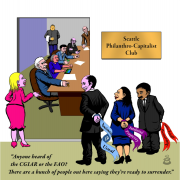
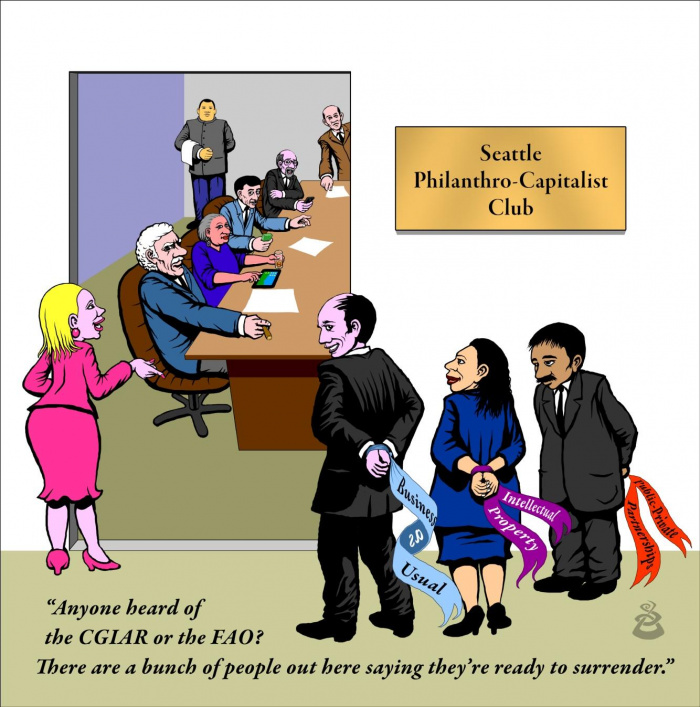
A new 30-page report that documents the growing influence of agribusiness on the multilateral food system and the lack of transparency in research funding has been released today by the international civil society organization ETC Group. The Greed Revolution: Mega Foundations, Agribusiness Muscle In On Public Goods, presents three case studies – one involving the UN Food and Agriculture Organization (FAO) and two involving CGIAR Centers (Consultative Group on International Agricultural Research) -- which point to a dangerous trend that will worsen rather than solve the problem of global hunger. The report details, amongst others, the involvement of Nestlé, Heineken, Monsanto, the Bill & Melinda Gates Foundation and Syngenta Foundation.
World’s Top 10 Chemical Companies
Submitted by ETC Staff on
The world’s 50 largest chemical corporations control a global market valued at $697 billion in 2009. The top 10 chemical firms account for about 40% of the market. “Petrochemicals,” by definition, are derived from petroleum and other fossil fuels. With soaring costs, unpredictable supplies and more challenging extractions, the industry is already making a transition from petrochemicals to biomass feedstocks. (In 2010, the world’s top 50 chemical corporations rebounded with combined sales of approximately $850 billion, an increase of 25.3% over 2009.)
World’s Top 10 Energy Companies
Submitted by ETC Staff on
ndustry statistics on world energy consumption put the “Green Economy” in much-needed perspective: In 2010 the world’s energy consumption grew by 5.6% - faster than any year since 1973.31 Fossil fuels accounted for 88% of the world’s primary energy (oil 34%; coal 30%; gas 24%). Nuclear, hydroelectric and “renewables” account for the remaining 12%. Non-hydro “renewables” (wind, geothermal, solar, biomass and waste) – including biofuels – account for 1.8% global energy consumption. World biofuels production grew by 14% in 2010 – but accounted for just one-half of one percent of global primary energy consumption. The world's top 10 energy companies account for 25% of the estimated $7 trillion energy market. Many of the world’s largest energy enterprises are high-profile investors in synthetic biology. Not only do they seek a cleaner, greener image; they believe that future profits will depend on diversifying and controlling bio-based feedstocks for energy production.
World's 10 Largest Water Companies
Submitted by ETC Staff on
|
Company
(Headquarters)
|
|---|
The Greed Revolution
Submitted by ETC Staff on
Big foundations like Gates and giant agribusinesses like Syngenta are taking an interest in multilateral public institutions committed to ending hunger. The international agencies are having trouble with the “public/private” boundaries. It’s time to evaluate them all.
ETC Group dedicates this Communiqué to the memory of Dr. Erna Bennett who passed away at the beginning of January 2012.
Issue: Three recent incidents show that the UN’s Food and Agriculture Organization (FAO) and the Consultative Group on International Agricultural Research (CGIAR) seem to be redacting their reports, or opening their gene banks and looking the other way as the private sector overrides governments and farmers to commandeer agricultural policy and practice. Private foundations and OECD states are causing public institutions to lose their focus on “public goods.”
Who Will Control the Green Economy?
Submitted by ETC Staff on
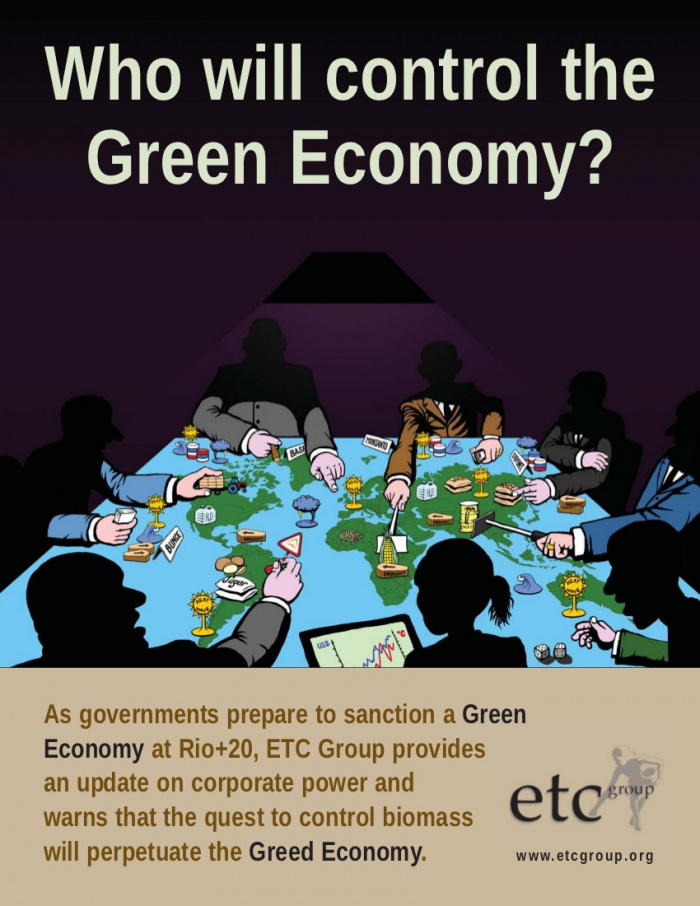
Will a “great green technological transformation” bring about a “green economy” to help us save ourselves and our planet? Or will it serve those already controlling today’s “greed economy?” In its new report, ETC Group provides a snapshot of the state of corporate control in more than a dozen economic sectors relevant to the green economy (including seeds, energy, bioinformatics and food) and argues that in the absence of effective and socially responsive governance, the green economy will spur even greater convergence of corporate power and unleash the most massive resource grab in more than 500 years.
What you will find in the 'Who Will Control the Green Economy?' Report
- Naming The Green Economy's “One Percent”
'Who Will Control the Green Economy?' provides hard data on the largest and most powerful corporate players controlling 25 sectors of the 'real economy'. This is the only freely available report to assemble top 10 listings of companies (by market share) from 18 major economic sectors relevant to the Green Economy. These lists include the top 10 players in Water, Energy, Seeds, Fishing and Aquaculture, Food Retail and Processing, Chemicals, Fertilizer, Pesticides, Mining, Pharmaceuticals, Biotech, the Grain Trade and more. The report also identifies the leading players in a handful of new and emerging industrial sectors including Synthetic Biology, Big Data, Seaweed and Algae production and Livestock Genetics (pp.1-2).

Earth Grab: Geoengineering, biomass and climate-ready crops
Submitted by ETC Staff on
Earth Grab - Geopiracy, the New Biomassters and Capturing Climate Genes' - essential, cutting-edge climate science in everyday language - published this week (27 October 2011). The authors reveal information that the large corporations who profit from climate change do not want the public to know.
'Earth Grab' analyses how Northern governments and corporations are cynically using concerns about the ecological and climate crisis to propose geoengineering 'quick fixes'. These threaten to wreak havoc on ecosystems, with disastrous impacts on the people of the global South. As calls for a 'greener' economy mount and oil prices escalate, corporations are seeking to switch from oil-based to plant-based energy.
minent environmentalist Vandana Shiva, founder of the Research Foundation for Science, Technology and Ecology, writes in her foreword that this research 'pulls back the curtain on disturbing technological and corporate trends that are already reshaping our world and that will become crucial battlegrounds for civil society in the years ahead'.
The book has already captured the attention of writer Naomi Klein, who writes that this 'crucial book reveals ... Indispensable research for those with their eyes wide open'. Campaigner George Monbiot adds that its exploration of 'three crucial issues which will come to dominate environmental and human rights debates in the coming years make it an essential resource for anyone trying to keep up with the times'.
“Hold Your Hoses!”
Submitted by ETC Staff on
Opponents of proposals to “geoengineer” the planet have two reasons to celebrate this week.
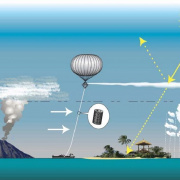
Firstly, ETC Group has learned that UK scientists, in the midst of controversy, are on the cusp of postponing an imminent test of an experimental hose (dubbed the “Trojan Hose” by opponents) designed to deliver sulphur dioxide to the stratosphere as a way to engineer a cooler planet. The test had been scheduled for October; on Monday, 60 groups from around the globe sent an open letter to the UK government and the research councils involved expressing their opposition to the experiment. No public announcement of the decision has been made and details must be clarified, but an undeniable lack of prior stakeholder engagement is the likely reason for the delay.
Open letter about SPICE geoengineering test
Submitted by ETC Staff on
We are writing to express our concern about the SPICE research project, which is managed by the University of Bristol in collaboration with the Universities of Oxford, Cambridge and Edinburgh, as well as military contractor Marshall Aerospace. The £1.6 million project has been funded by the Engineering and Physical Sciences Research Council (EPSRC) and the Natural Environment Research Council (NERC), supported by the Science and Technology Facilities Council (STFC). We are calling upon the UK government and the Research Councils involved to suspend the project. In particular, we believe the experiment planned to test equipment for injecting particles into the stratosphere with the aim of counteracting global warming through solar radiation management (SRM) should be cancelled.
ETC Group calls on UK government to halt Geoengineering Experiment
Submitted by ETC Staff on
In response to reports that British scientists are about to test the hardware needed to put sulphur particles in the stratosphere as a climate technofix, international technology watchdog ETC Group is calling on the UK government to halt the controversial test and respect UN processes underway to discuss these issues.
IPCC treads carefully on geoengineering
Submitted by ETC Staff on
As the Intergovernmental Panel on Climate Change (IPCC) wound up its expert meeting on geoengineering in Lima, Peru, which included all three IPCC Working Groups, it committed to remain “policy relevant but not policy prescriptive.” Despite getting off on the wrong foot (no transparency), with some of the wrong experts (scientists with financial interests), on some of the wrong topics (governance), the IPCC has now confirmed that it will not make recommendations to governments regarding research funding for the controversial technologies, governance models or the legality of experimentation.
At a press briefing following the close of the expert meeting, the IPCC stated that its focus will be “establishing the scientific foundations for an assessment of geoengineering.” This assessment would include risks, costs, benefits and social and economic impacts, intended and unintended consequences as well as uncertainties and gaps in knowledge and will be based solely on peer-reviewed literature. “Of course, a real assessment of geoengineering will need to be much broader than a scientific peer-review process,” said Silvia Ribeiro of ETC Group from Lima, though outside the meeting. “Civil society organizations have been clear that we do not want these dangerous technologies developed; they are a new threat from the very same countries that are responsible for the climate crisis in the first place!”
Civil Society Organizations to IPCC: Take Geoengineering off the Table!
Submitted by ETC Group on
125 international and national organizations, representing at least 40 countries from all continents, sent an open letter to the Intergovernmental Panel on Climate Change (IPCC), demanding a clear statement of its commitment to precaution and to the existing international moratorium on geoengineering. The IPCC will hold an expert meeting on geoengineering 20-22 June in Lima, Peru.
Open letter to IPCC on geoengineering
Submitted by ETC Staff on
The undersigned organizations would like to express our concerns about the upcoming IPCC joint working group expert meeting on geoengineering to be held in Lima, Peru, June 20-22, 2011.
Presentation by Pat Mooney to the UNGA on June 2 2011
Submitted by ETC Group on
Next year’s UN conference in Rio de Janeiro should mark the beginning of a new era of environmental and economic cooperation. Rio +20 is not only the 20th anniversary of the Earth Summit, it is also Stockholm+40 – marking the UN’s first major environmental conference, and, somewhat ominously, it is also the 50th anniversary of the publication of Rachel Carson’s groundbreaking Silent Spring. As we prepare for 2012, we have 50 years of environmental history to bear in mind.
The Sins of Syn Bio. Article from Slate Magazine - Feb 2nd 2011
Submitted by ETC Staff on
Here's a grim prediction to chew on. This biotech craze dubbed "synthetic biology"—where hipster geeks design quirky life-forms: That technology is going to wind up costing lives—likely a lot of them. I'm not suggesting a direct kill by rogue viruses. These will be economic deaths. The dead will not be noteworthy: farmers, pastoralists, and forest dwellers who live in poor nations that depend on plant commodities.
Syn bio is feted as the next big thing, but we should be clear-eyed about what makes syn bio such a big deal and about whom it will harm. Its advocates predict that synthetic bio will lead to the "New Bioeconomy," in which we harness biology to perform tasks now accomplished by manufacturing.
The New Bioeconomy seems innocently green. It involves yeast and bacteria being repurposed as bio-factories to churn out the plastics, chemicals, and fuels we are already addicted to. Since microbes feast on plant-stuff—whether algae, wood chips, or sugar—plants would replace petroleum as the key feedstock for industrial production. The sourcing of strategic raw materials, including medicines, rubber, and oils, will shift from the hands of farmers in the global South to fermentation vats controlled by the North.
New Report on Global Governance of Nano-scale Technologies
Submitted by ETC Staff on
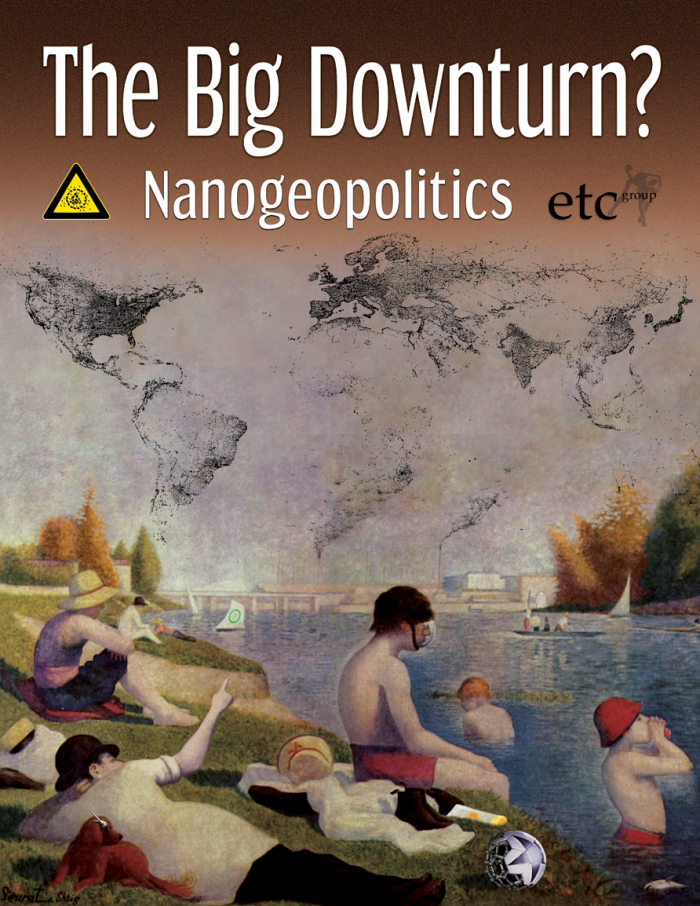
ETC Group brings a new report – "The Big Downturn? Nanogeopolitics" to the conversation at the World Social Forum in Dakar, Senegal, 2011. ETC Group’s 68-page report provides a current snapshot of global investment, markets, governance and control of nanotechnology, including patenting.
ETC Group at the World Social Forum 2011
Submitted by ETC Staff on
This week (02/2011) ETC Group travels to Dakar to meet friends and partners – new, old and yet-to-be – to learn, listen and share information about corporate power and emerging technologies, including their impacts on marginalized communities. In the run-up to the Rio+20 Summit in May 2012, the international community will be confronted with a challenging list of so-called ‘green economy’ technology and policy proposals – as well as major agricultural and environmental institutional decisions.