Seeds, Biotech, Agrochemicals D.A.M.N.D.
Submitted by ETC Staff on
Agricultural biotechnology is intensely concentrated in the hands of four or five life industry corporations. Provides a snapshot of five industry giants.

Submitted by ETC Staff on
Agricultural biotechnology is intensely concentrated in the hands of four or five life industry corporations. Provides a snapshot of five industry giants.
Submitted by ETC Staff on
The hesitancy with which the US Patent and Trademark Office (PTO) began granting animal patents in 1988 has all but disappeared, and today the practice is accelerating dramatically (see chart). The recent trend is fueled by a backlog of patent applications, rapid advances in biotechnologies and the promise of commercial markets for transgenic animals and the therapeutic proteins they produce. Based on the US trend, the European Union can expect hundreds of backlogged animal patents to begin issuing if the European Patent Directive is adopted - as expected - by the European Parliament's Council of Ministers later this year.
Submitted by ETC Staff on
It's not whether drug companies need patents to create new drugs - but whether society can survive monopoly control over medical research, according to research undertaken by RAFI (Rural Advancement Foundation International). The world's drug industry represents a health risk and cannot be entrusted with the task of medical research," Pat Mooney, executive director of RAFI insists.
Submitted by ETC Staff on
If you have a close eye on bioprospecting, you may have heard about the particularly grandiose plans of the International Organisation for Chemical Sciences in Development's (IOCD) Biotic Exploration Fund". The Fund is a major international effort to promote bioprospecting originally proposed by Thomas Eisner, an academic who "conceived and facilitated" the Merck/InBio deal in Costa Rica. IOCD has hired a former Science and Technology Adviser to the World Bank to push the Fund, which is being aggresively promoted to many potential Northern funding agencies.
IOCD, a Belgian-chartered international NGO with a legal identity in the United States, is unabashedly fanatical about the potential for bioprospecting to protect the environment and be a "sustainable source of economic development." In fact, according to IOCD, without bioprospecting, the world's diversity may be doomed: "In comparison with the severity of the global biodiversity crisis, the amount of bioprospecting in developing countries is clearly far too small. Hence, the only appropriate response to the global crisis would be a great expansion of the scale and quality of bioprospecting throughout the developing world."
Submitted by ETC Staff on
Company Estimated 1996 seed sales (US) millions Comment
Pioneer Hi-Bred Intl. (USA) $1,721 Dupont now owns 20% share in Pioneer
Novartis (Switzerland) $991 formerly Ciba Geigy and Sandoz
Limagrain (France) $552 French cooperative; claims to be the world's largest vegetable seed company.
Advanta - joint venture of Zeneca/Van der Have (The Netherlands) $493 Zeneca and Royal VanderHave established joint venture in 1996. The name of their merged company is Advanta
Submitted by ETC Staff on
Just when we thought that the U.S. patent system couldn't possibly operate any more to the advantage of big business, there's a bill before the US Congress that proposes to modernize" the US Patent and Trademark Office by making it a private corporation. (1)
Privatization of the US PTO? This is not a joke. HR 400, "The 21st Century Patent System Improvement Act" is a series of six acts that propose major changes in the US patent system. Backed by powerful interests, the bill is moving quickly through Congress, and a vote is expected in the House of Representatives any day.
Submitted by ETC Staff on
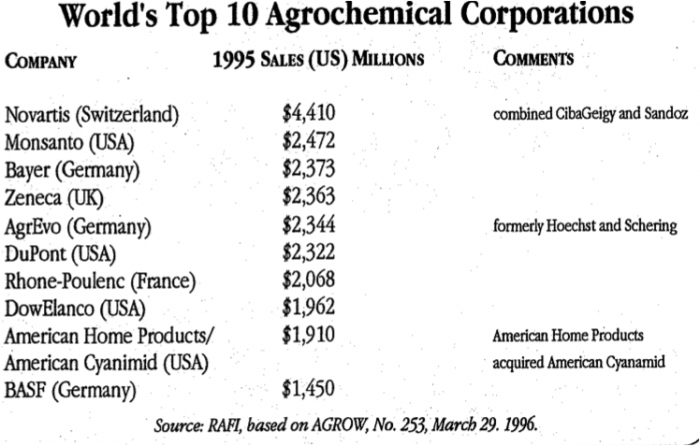
This is RAFI's first annual update on the "Life Industry" - the giant transnational enterprises that use, buy, sell and control an ever-growing market share of bio-industrial products relating to food, agriculture and health. A list of the top 10 corporations, ranked by 1995 sales, is given for each sector.
Submitted by ETC Staff on

This document reviews the year-long controversy over Agracetus's species-wide patent on all genetically modified soybean varieties. In April 1994, with the support of 18 CSOs worldwide, RAFI announced it would formally challenge the patent at the European Patent Office. A summary of RAFI's opposition statement appears here. A 14 page document.
Submitted by ETC Staff on
One of the most eagerly awaited publications in the plant genetic resources (PGR) community. - Diversity 1994, 10(2), 25
The recent GATT agreement and the Biodiversity Convention have moved intellectual property rights to the centre of South-North relations.
Decisions about intellectual property, particularly for plant life, have major implications for food security, agriculture, rural development, and the environment for every country in the South and the North. For the South, in particular, the impact of intellectual property on farmers, rural societies, and biological diversity will be profoundly important.
* Patents granted for genetically engineered cotton could profoundly influence the future of a $20 billion crop critical to many national economies in the South.
* Farmers' organizations in Andean countries believe that patents granted for two varieties of coloured cotton do not recognize the major contribution to the new product by indigenous communities in South and Central America.
Submitted by ETC Staff on
Agracetus, a subsidiary of W.R. Grace, receives a shockingly broad US patent covering all genetically engineered cotton varieties. This is the first reported case where one patent covers all transgenic plants of an entire species.
Submitted by ETC Staff on
RAFI warns that the Human Genome Diversity Project's outrageous proposal to collect human DNA from 722 communities around the world has serious implications for indigenous peoples. Will profits be made from the genes of poor people whose physical survival is in question? Who will have access and what benefits will accrue to indigenous communities?
Submitted by ETC Staff on
Authored by Cary Fowler and Pat Mooney, this 270 page book provides an excellent introduction to the history and geopolitics of genetic diversity. Published in 1990.
Submitted by ETC Staff on
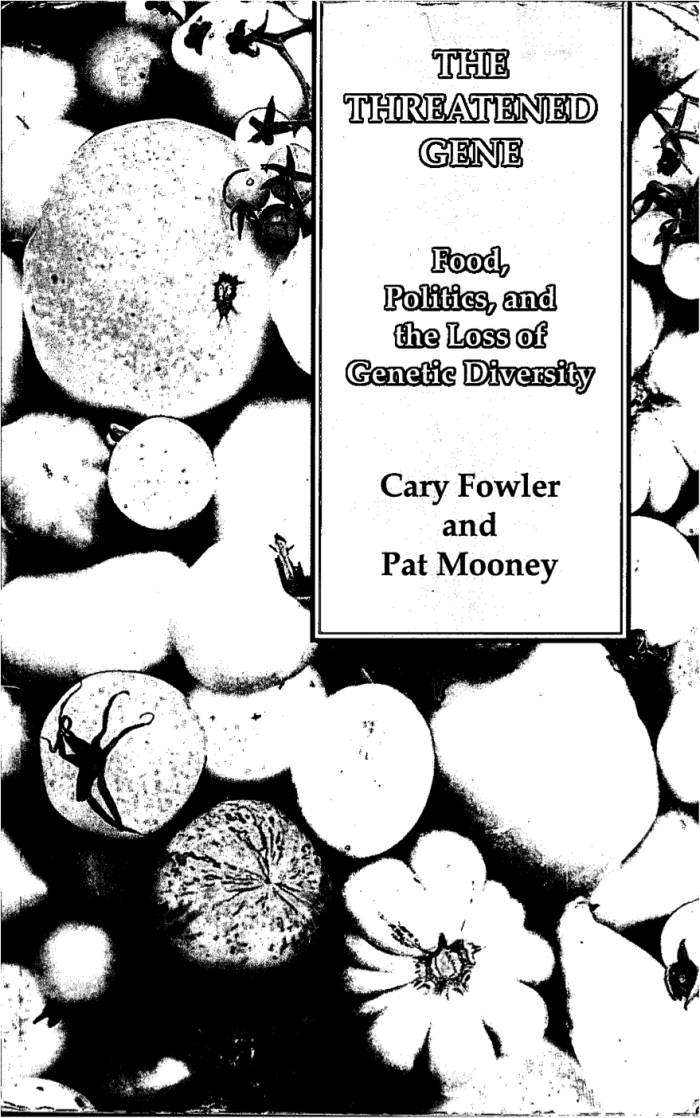
Also published under: The Threatened Gene: Food, Politics, and the Loss of Genetic Diversity
Description: Authored by Cary Fowler and Pat Mooney, this 270 page book provides an excellent introduction to the history and geopolitics of genetic diversity. Published in 1990.
Submitted by ETC Staff on
Three Developments in Plant Biotechnology: The Particle Gun, RFLP Tech; and New Hybrid Crops and the companies that control them.
Submitted by ETC Staff on
Agricultural inputs (seeds, pesticides, fertilizers) are undergoing majore corporate and technological change.
Submitted by ETC Staff on
The use of genetic engineering to make plants tolerant of the damaging effects of herbicides.

Find out more about ETC Group, or contact us.