Recent content

World’s Largest Geoengineering Deployment Off Coast of Canada’s British Columbia

Commercial geoengineer obtained more than $1 million of community funds; Governments meeting in Hyderabad, India to discuss oversight of geoengineering

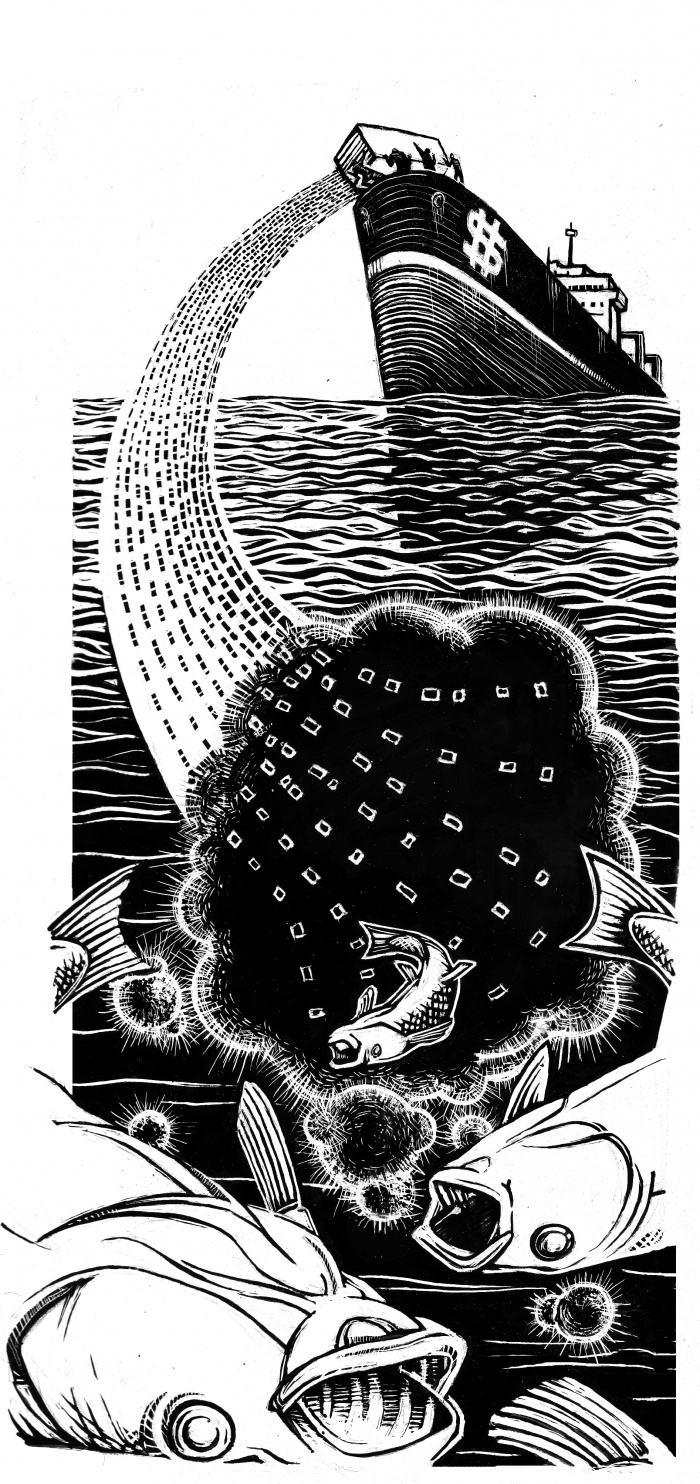
More information about the world’s largest geoengineering deployment to-date has come to light since news of the iron-dust dump made headlines on Monday. The so-called ‘Haida Salmon Restoration Corporation’ (HSRC) claims it dumped 100 tonnes of iron particles into the Haida Eddy of the north-east Pacific Ocean to produce an artificial plankton bloom, even though the practice is prohibited by globally agreed moratoria and Canadian law. The CEO of HSRC, John Disney, claims that several Canadian government agencies – including Environment Canada – were apprised of HSRC’s ocean fertilization plans before deployment. Canada’s Environment Minister says an investigation is underway and the dump would be illegal if it indeed happened.

Statement by Environment Canada regarding HSRC Ocean fertilization Dump

Issued to Press on october 17th 2012


From: Sweet,Adam [NCR] [mailto:Adam.Sweet@ec.gc.ca] 
Sent: October-17-12 4:24 PM
 

Environmental protection and enforcement is a priority of our government. Under Budget 2012, we increased the levels of fines, and we have also recently increased the number of enforcement officers.

Full Press Coverage of 2012 Ocean Fertilization Scheme Near Haida Gwaii

In mid-october 2012 ETC Group, working with partners, uncovered a large-scale unauthorised geoengineering scheme that had been carried out in July 300km off the west coast of Canada, close to the islands of Haida Gwaii. We discovered that this ocean fertilization scheme, which involved at least 120 tons of iron dust and iron sulphate being dumped into a highly biodiverse marine ecosystem, appeared to have given rise, at least in part, to an unusually large (10,000 sq km) plankton boom. We also learned that the principal actor behind this large dump of iron was Russ George formerly CEO of Planktos, a company that had attempted to dump iron in the waters west of the Galapagos Islands and the Canary islands in 2007. In ETC Group's view this activity violated at least three international moratoria established through the IMO's London Convention and the UN Convention on Biological Diversity.

This page presents a partial record of the media reporting and scientific and official responses to this large real-world geoengineeirng scheme.

El ABC para asegurar la precaución en la geoingeniería

Información para delegados a la COP11 del CDB

En octubre de 2010 en Nagoya, las Partes del CDB adoptaron una decisión crucial, poner en moratoria las pruebas y despliegue de tecnologías de geoingeniería (Decisión X/33 para 8w) —reconociendo la amenaza particular a la biodiversidad y las formas de sustento. Esa moratoria marcó la primera vez que un organismo internacional comenzó a establecer la supervisión de este campo emergente. La Decisión X/33 de la COP10 también incluyó una llamada para la realización de tres estudios: sobre los impactos en la biodiversidad, sobre gobernanza y sobre puntos de vista y experiencias de comunidades indígenas y otras (resumido en UNEP/CDB/SBSTTA/16/10). Esos estudios tienen el objetivo de dar insumos para una supervisión adecuada precautoria de la geoingeniería en su relación con la biodiversidad. Esos tres estudios han sido complementados y revisados por SBSTTA y se requerirá que las Partes decidan los pasos siguientes bajo el ítem 11.2 de la agenda de la COP11.

El Grupo ETC propone que las partes reunidas en Hyderabad adopten un “ABC” de la precaución

The ABCs of Ensuring Precaution on Geoengineering

A briefing for delegates to CBD COP11

In October 2010 in Nagoya, Parties to the CBD adopted a landmark decision to place a moratorium on the testing and deployment of geoengineering technologies (Decision X/33 para 8w) – recognising the particular threat to biodiversity and livelihoods. That moratorium marked the first time an international body had begun to establish oversight over this new field.

From 8th - 19th October 2012 the CBD will be meeting again at COP11 at Hyderabad India. ETC Group proposes that parties meeting in Hyderabad adopt an “ABC” of precaution:

Biología Sintética: 10 puntos clave

Información para delegados a la COP11 del CDB

En la COP11, se pedirá a los negociadores de los gobiernos que consideren someter a la supervisión del Convenio sobre Diversidad Biológica una nueva área de actividad industrial. La biología sintética es un campo tecnológico floreciente que construye sistemas genéticos artificialmente y programa formas de vida para que tengan usos industriales. La biología sintética requiere urgentemente una gobernanza efectiva. Este documento informativo detalla 10 puntos clave a considerar.

Synthetic Biology - 10 key points for delegates

At COP 11, government negotiators will be asked to consider bringing a new and emerging area of industrial activity under the oversight of the Convention on Biological Diversity. Synthetic Biology is a burgeoning technological field that builds artificial genetic systems and programmes lifeforms for industrial use. It urgently requires effective governance. This briefing details ten key points to consider.

Los diez acaparamientos de tierra más peligrosos desde 2007

Control del agua y la tierra

La demanda de alimentos, forrajes y otras formas de biomasa vegetal —así como de otros recursos estratégicos como los minerales y la madera— constituye el principal impulso para el acaparamiento global de tierras. El control de los recursos hídricos es otro factor principal.

Distribuir nuestras investigaciones

El Grupo ETC agradece cualquier oportunidad de distribución de nuestros materiales. Todos nuestros reportes, briefings, boletines de prensa, etc., están disponibles en nuestro sitio web como PDF, listos para imprimir y/o copiar. No existe ningún pago de derechos por copiar o distribuir nuestros textos.

Animamos a individuo y grupos a:

-Hacer copias de nuestros informes, tablas, gráficas, para colectivos, bibliotecas, etc.

Control super consolidado de las trasnacionales

147 compañías controlaron casi el 40% del valor monetario de todas las corporaciones trasnacionales en 2007.

147 compañías controlaron casi el 40% del valor monetario de todas las corporaciones trasnacionales en 2007.
Son los resultados de un estudio publicado en julio de 2011 por investigadores en Suiza, (ETH Zurich), basados en el análisis de 43,060 corporaciones trasnacionales ubicadas en 116 países. Solo 137 firmas dieron cuenta del 80% del valor de todas las corporaciones trasnacionales.

Qué sabemos de Río

Río+20 debe lograr que las políticas sobre tecnología en este siglo 21 retomen el principio de precaución, el desarrollo de una evaluación participatoria de las tecnologías y una prohibición exhaustiva de las diversas formas de la geoingeniería.

El Grupo ETC presenta su nuevo sitio web

Necesitamos su ayuda para hacerlo mejor

Bienvenidos al nuevo sitio web del Grupo ETC. Si bien aún estamos en el proceso, y necesitamos afinar varias cosas, pensamos que la nueva versión de nuestra página es mucho mejor que la anterior y no podíamos demorarla por más tiempo.
Agregamos muchas nuevas características que ayudarán a encontrar, usar y compartir el contenido de la manera más fácil posible, ya sea que el lector nuevo en los temas o todo un experto. Por favor tengan paciencia con los inconvenientes temporales. Estamos trabajando en los errores de adaptación pero sean tan amables de reportar fallas que ustedes encuentren usando el botón [+] feedback, en la misma página en que vean la falla.

Hasta pronto,
Grupo ETC

Super-Consolidated TNC Control

147 companies controlled nearly 40 percent of the monetary value of all transnational corporations in 2007.

147 companies controlled nearly 40 percent of the monetary value of all transnational corporations in 2007.
That’s the finding of a new study published in July 2011 by researchers at Switzerland’s ETH Zürich, based on an analysis of 43,060 transnational corporations (TNCs) located in 116 countries. Just 737 firms account for 80% of the value of all TNCs.

There are currently over 500 Multilateral Environment Agreements

Since the Stockholm Conference of 1972, there has been a proliferation of treaties, agreements and institutions, but the money hasn’t matched the meetings and the decisions haven’t been matched with democratic participation. The multilateral system’s environmental response has been incongruously ad hoc and also ad nauseum. Among the indicators…

Páginas

Suscribirse a Recent content