Fear-Reviewed Science: Contaminated Corn & Tainted Tortillas
Submitted by ETC Staff on
ETC group explores the fractious scientific and political debate surrounding GM maize contamination in Mexico.
Submitted by ETC Staff on
ETC group explores the fractious scientific and political debate surrounding GM maize contamination in Mexico.
Submitted by ETC Staff on
The World's Largest Agrochemical and Seed Enterprises --Syngenta & DuPont -- Win Two New Patents on Genetic Seed Sterilization
The ETC group (formerly RAFI) announced today that the biotechnology industry continues to aggressively pursue the development of genetically modified seeds that are engineered for sterility. "We have uncovered two new patents on Terminator technology," said Hope Shand, Research Director of ETC group. "One patent is held by Dupont (the world's largest seed corporation) and the other is held by Syngenta (the world's largest agrochemical corporation)," said Shand.
Submitted by ETC Staff on
Terminator technology--the genetic modification of plants to produce sterile seeds--is a global threat to food security, to poor farmers, and to biodiversity. ETC group is campaigning with civil society organizations worldwide for a ban on Terminator, which has been condemned by civil society, scientific bodies and many governments as an immoral application of agricultural biotechnology.
Submitted by ETC Staff on
This week, Mexico's indigenous farmers and civil society organizations will meet in Mexico City (Jan. 23-24) to decide what to do about GM contamination in one of the world's mega-centres of agricultural biodiversity. Meanwhile, the scientific community is imploding with angst and accusations as the "Peers" of the Plant Realm squabble over the implications for global food security.
The ETC group (formerly RAFI) is releasing a new Communiqué today in an attempt to summarize the fractious scientific and political debate surrounding GM maize contamination in Mexico. The full text is available at www.etcgroup.org. The Communiqué is also a contribution to the Mexico City seminar of which ETC group is among the sponsoring organizations. For further background on the seminar, contact Silvia Ribeiro in Mexico City: silvia@etcgroup.org
Submitted by ETC Staff on
The world's centres of crop genetic diversity are the part of biodiversity that feeds people. The gene banks within those centres are critical for global food security. Now, the MesoAmerican centre is contaminated with genetically modified (GM) material and its most important gene bank may be contaminated as well.
Submitted by ETC Staff on
This Communique identifies new mechanisms - ranging from remote sensing technologies, biological monopolies, and legal contracts - that are being developed by a broad range of industries to strengthen corporate dominance over new technologies. The political, practical and technical uncertainties surrounding intellectual property are increasingly unacceptable to industry - and that is why companies are developing new tools for monopoly control- what ETC group calls "New Enclosures."
Submitted by ETC Staff on
A new report by ETC Group argues that the pharmaceutical industry's major interest in "The Book of Life" and parallel advances in neurosciences lies in the development of new drugs and therapies that target "well people" rather than the ill. The study also shows that company strategies focusing on parents could eliminate the "different" in the human species in favour of a monocultural "norm." In addition, industry and government are exploring the potential to use the new genomics to monitor and control dissent.
Submitted by ETC Staff on
Issue: For five years now, public concern about genetic engineering has been riveted on GM crops and foods. But, advances in mapping the human genome have spawned new pharmaceutical industry opportunities. While the prospects for human cloning and stem cell therapies grab the headlines and divert our attention, the companies are pursuing more strategic agendas. Although the majority oppose reproductive cloning, public and policy opinion is 'soft.' Industry's latest and most lucrative market - Human Performance Enhancement drugs - 'HyPEs' - are not even on the policy agenda.
Submitted by ETC Staff on
Delta & Pine Land, the maverick seed company that vows to commercialize the notorious Terminator technology, is in trouble. Delta & Pine Land announced (2001) that its president is quitting, the company will eliminate 7 percent of its work force and they are shutting down a facility in Arizona.
Submitted by ETC Staff on
Issue: Concentration in corporate power is the defining feature of today’s (2001) global economy. The “life sciences” industry is converging into new corporate structures that have profound implications for every aspect of commercial food, agriculture, and health.
Submitted by ETC Staff on
It's official. The US Department of Agriculture announced this week that it has concluded negotiations to license the notorious Terminator technology to its seed industry partner, Delta & Pine Land (D&PL). As a result of joint research, the USDA and D&PL are co-owners of three patents on the controversial technology that genetically modifies plants to produce sterile seeds, preventing farmers from re-using harvested seed. A licensing agreement establishes the terms and conditions under which a party can use a patented technology. Although many of the Gene Giants hold patents on Terminator technology, D&PL is the only company that has publicly declared its intention to commercialize Terminator seeds.
Submitted by ETC Staff on
The world's leading seed trade association, ASSINSEL (International Association of Plant Breeders for the Protection of Plant Varieties, Nyon, Switzerland) may have succumbed to political pressure from the USA and four other OECD governments. The trade group has reversed its position in support of a new global treaty to safeguard the exchange of research seed for food security. The policy turnabout apparently came during the trade group's annual meeting in Sun City (popularly known as 'Sin City' because of its casinos). ASSINSEL is expected to tell governments at the UN Food and Agriculture Organization in Rome next Monday (June 25th) that it, '...does not support the current IU [International Undertaking, the treaty] text...'. The statement will come as a shock to European governments and to diplomats from Africa, Asia, and Latin America attending the Undertaking's final negotiating round June 25-30.
Submitted by ETC Staff on
A new US patent, awarded to Monsanto on 16 January 2001, has blind-sided biotech scientists and threatens to knee-cap public sector research because it gives Monsanto exclusive monopoly rights on a crucial method of identifying modified plant cells in the laboratory.
Submitted by ETC Staff on
ETC Group Censored! The 25th Anniversary Edition of the Top Censored Stories of the Year, 2001 features critical social issues that have been under-reported or ignored in the mainstream media. ETC Group is the recipient of two Project Censored awards, and both are featured in this book. Biopiracy in Chiapas and the efforts of local indigenous peoples to defeat the US-government funded International Cooperative Biodiversity Group (ICBG-Maya) is one of the award-winning issues identified by Project Censored in 2000.
Submitted by ETC Staff on
World's Largest Agrochemical and Seed Enterprise Holds Growing Arsenal of Terminator and Traitor Technologies
Syngenta, the world's largest agribusiness firm, was formed on 13 November 2000 with the merger of AstraZeneca and Novartis. The next day the company won its newest Terminator patent, US Patent 6,147,282, 'Method of controlling the fertility of a plant.' (The patent was issued to Novartis - but the company's intellectual property goes to Syngenta.) With pro forma 1999 sales of US $7 billion, Syngenta is the world's largest agrochemical enterprise, and the third largest seed corporation.
Submitted by ETC Staff on
This issue {1999:1-2 [2001]} of Development Dialogue, published by the Dag Hammarskjold Foundation, was authored by Pat Mooney. The ETC Century discusses trends in technological transformation, environmental and cultural erosion, and the re-organization of economic power into the hands of high-tech global oligopolies. This publication is 128 pages.
Submitted by ETC Staff on
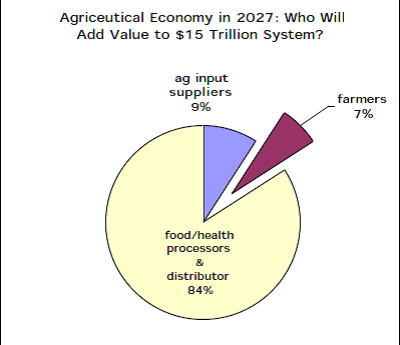
Biotech's 3rd Generation refers to products that will offer perceived health, nutrition or lifestyle benefits for consumers. The lure of a technologically-integrated $15 trillion system will attract whole new corporate configurations. The Gene Giants may slip down the food chain when the food & beverage industry or the grocery retailers buy into Generation 3.
Submitted by ETC Staff on
La biodiversidad en el mundo no está repartida equitativamente, aunque es la base de todos los sistemas naturales. Siete por ciento del planeta, coincidente con las áreas de bosques tropicales, alberga más de la mitad de la biodiversidad que se conoce en el mundo. México es uno de los países llamados megadiversos, ubicándose entre los cinco primeros lugares en diversidad de especies de fauna y flora, de bosques y otros ecosistemas. También es un centro privilegiado de origen y diversidad de especies cultivadas.
La mayor diversidad cultural del planeta está en las mismas zonas. No es casualidad. Es causalidad. Durante miles de años ha existido una relación de apoyo mutuo entre la diversidad biológica y la diversidad cultural. Millones de indígenas y campesinos han ido adaptando y adaptándose al medio, a través del uso y la domesticación de recursos biológicos para su sustento: alimentación, vivienda, abrigo, medicinas, objetos rituales y para el placer ético y estético. La diversidad no es un fenómeno separado de la gente. Tiene actores: son los campesinos –y fundamentalmente las campesinas-, los agricultores de pequeña escala, las poblaciones locales tradicionales e indígenas.
Submitted by ETC Staff on
In a split 2-1 decision, the Canadian Federal Court of Appeal ruled in favour of granting a patent to Harvard Medical School for the oncomouse, a mouse genetically engineered to carry a cancer-causing gene. The decision marks another point in the 15-year battle in the Canadian courts over whether Mother Nature or a Harvard scientist invented the mouse and its offspring.
Submitted by ETC Staff on
Two days of contentious debate on Terminator has ruptured the US Department of Agriculture's (USDA) Advisory Board on Agricultural Biotechnology. Terminator technology, the genetic engineering of plants to produce sterile seeds, has been widely condemned as a dangerous and morally offensive application of agricultural biotechnology, because over 1.4 billion people depend on farm-saved seeds.
USDA ignited the worldwide controversy in March 1998 when it won the first of three patents on genetic seed sterilization, which it holds jointly with Delta & Pine Land - the world's largest cotton seed company.
Find out more about ETC Group, or contact us.