Recent content

Civil Society/Labor Coalition Rejects Fundamentally Flawed Dupont-ED Proposed Nanotechnology Framework

Urges All Parties To Reject The Public Relations Campaign

To All Interested Parties:

We, the undersigned, submit this open letter to the international nanotechnology community at large. We are a coalition of public interest, non-profit and labor organizations that actively work on nanotechnology issues, including workplace safety, consumer health, environmental welfare, and broader societal impacts.

DuPont Chemical Company (DuPont) and Environmental Defense (ED) jointly have proposed a voluntary “risk assessment” framework for nanotechnology. These groups intend to circulate their proposed framework both in the U.S. and abroad for consideration and/or adoption by various relevant oversight organizations, including the U.S. Environmental Protection Agency (EPA).

2006 and the plutocracy

2006 and the plutocracy
Inglés

In this article the author makes a very enlightening summary of corporate concentration during 2006, and how this affects our lives as simple citizens even though we think its something happening far away by Silvia Ribeiro Corporate concentration through global mergers and acquisitions reached a record at the close of 2006.

Gambling with Gaia

With hopes for Kyoto dimming, some governments may conclude that massive earth restructuring is the only feasible way out

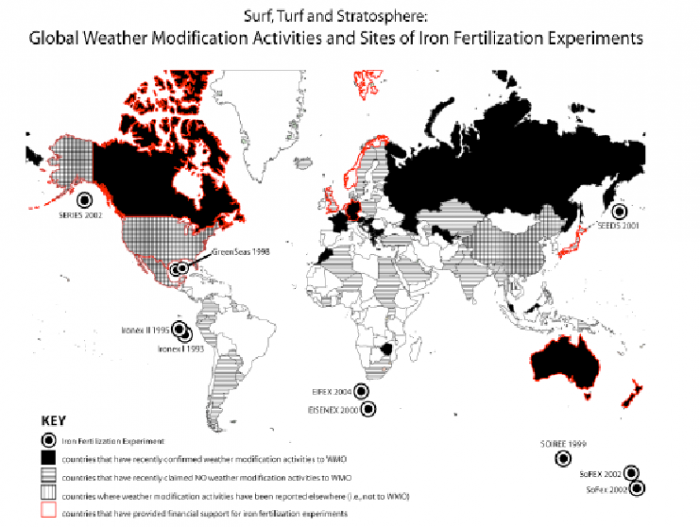
Issue: Kyoto is fading and carbon trading is a farce. Recognizing this, OECD states can either “bite the bullet” and adopt socially-responsible policies to dramatically cut fossil fuel use and useless consumption or, they can hope for a “silver bullet” – some new techno-fix that might let them have their cake and eat it too. The silver bullet may be winning. At the UN’s Intergovernmental Panel on Climate Change, the US government is lobbying for “geoengineering” activities such as deliberately polluting the stratosphere to deflect sunlight and lower temperatures. At least 9 national governments and the European Union have supported experiments to spread iron filings on the ocean surface to nurture plankton and sequester carbon dioxide. At least a dozen additional countries are involved in stratospheric weather/climate modification. Commercial carbon traders are engaging in ocean fertilization as well. The scientific debate and the government/commercial experimentation is taking place, once again, in the absence of public discussion.

Gambling with Gaia

ETC Group Warns that US Government’s Push for Geoengineering is Unacceptable

On the day before the United Nations Intergovernmental Panel on Climate Change (IPCC) sounds its loudest alarm yet, ETC Group warns that some OECD states, led by the United States, are betting on a pie-in-the-sky techno-fix to address climate change. “Geoengineering” refers to the intentional, large-scale manipulation of the environment to bring about environmental change. With no hope for Kyoto, little political will to ask industry or voters to change lifestyles and a growing recognition that carbon trading is a farce, some governments are concluding that massive earth restructuring is the only way out. The Guardian reported earlier this week that the US government is lobbying the IPCC to promote geoengineering activities, such as deliberately polluting the stratosphere to deflect sunlight and lower temperatures. (1)

Jugando con Gaia

Al ver cómo agoniza el Protocolo de Kioto, algunos gobiernos concluyen que una reestructuración planetaria es la única salida posible

Al tiempo que el Panel Internacional de Naciones Unidas sobre Cambio Climático (IPPC) hará pública su alarma más contundente hasta el momento, el Grupo ETC advierte que algunos países de la OCDE, encabezados por Estados Unidos, empujan por que se hagan solamente “arreglos técnicos” para enfrentar el cambio climático. El más extremo —la “geoingeniería”— se refiere a la manipulación intencional del ambiente a gran escala, para ocasionar cambios ambientales. Sin esperanzas de que funcione el Protocolo de Kioto, sin voluntad política para pedir a la industria y a los electores los necesarios cambios de producción y estilo de vida y sin poder negar las evidencias de que el comercio de emisiones de carbono es una farsa, algunos gobiernos empiezan a argumentar que la reestructuración masiva de la Tierra es la única salida. The Guardian reportó a principios de esta semana que el gobierno de Estados Unidos está cabildeando al IPCC para que promueva soluciones de geoingeniería, como contaminar deliberadamente la estratósfera para desviar la luz del sol y abatir las temperaturas.

Ganadores de la competencia para un logo de peligro nanotecnológico, anunciados en el Foro Social Mundial en Nairobi

Cientos de las 30 mil personas reunidas en el Foro Social Mundial celebrado esta semana en Nairobi, Kenya, votaron por su símbolo favorito para advertir contra el peligro nanotecnológico o los materiales diseñados con nanotecnologías (un nanómetro es inconcebiblemente pequeño: equivale a una mil millonésima parte de un metro).

Ingeniería genética extrema: El Grupo ETC publica su informe sobre Biología Sintética

Un nuevo informe del Grupo ETC concluye que los riesgos sociales y ambientales de la biología sintética rebasan con mucho los peligros y abusos de la biotecnolgía. El texto, de 70 páginas, puede descargarse sin costo alguno en el sitio web del Grupo ETC.

“La ingeniería genética es cosa del pasado,” afirmó Pat Mooney, Director Ejecutivo del Grupo ETC. “Hoy, los científicos no solo mapean genomas y manipulan genes, sino que están construyendo la vida desde cero, y sin debate social alguno o siguiendo normas de ningún tipo, afirmó Mooney.

Extreme Genetic Engineering: An Introduction to Synthetic Biology

ETC Group Releases Report on Synthetic Biology

A new report by the ETC Group concludes that the social, environmental and bio-weapons threats of synthetic biology surpass the possible dangers and abuses of biotech. The full text of the 70-page report, Extreme Genetic Engineering: An Introduction to Synthetic Biology, is available for downloading free-of-charge on the ETC Group website.

"Genetic engineering is passé," said Pat Mooney, Executive Director of ETC Group. "Today, scientists aren't just mapping genomes and manipulating genes, they're building life from scratch - and they're doing it in the absence of societal debate and regulatory oversight," said Mooney.

ETC Group: A Brief History

How we began: We began as a conversation about seeds in 1977. Four and a half decades later, we are still talking about seeds, but the world has grown infinitely more complex: new technologies have developed, economies have globalized, multinational companies have expanded their reach, and wealth and capital are concentrated in the hands of fewer and fewer giant corporations. Life itself has been manipulated, picked apart, re-assembled – and then patented.

Vlandas' comment

Dr. Alexis Vlandas is Nanotechnology spokesperson for International Network of Engineers and Scientists for Global Responsibility.

In addition to esthetical criteria I based my choice on symbols which conveyed the impression of loose particles freely dispersing. I indeed believe that the main worry comes from material that can easily disperse and thus easily enter the human body. It should be noted that even if particles are initially embedded in a media, great care has to be taken to assess the whole cycle of life of the product so that even when it is disposed of the nano-particulate remain trapped.

ETC Group testifies at US Food & Drug Administration's public meeting on nanotechnology

“100 Years after The Pure Food & Drug Act: FDA’s current regulatory framework inadequate to address new nano-scale technologies”

Presentation of Kathy Jo Wetter on behalf of ETC Group

Thank you for the opportunity to present the views of ETC Group. We are an international civil society organization based in Canada. Our work focuses on the social and economic impacts of emerging technologies and their implications, especially for marginalized communities. I’m based in ETC Group’s North Carolina office.

En Estados Unidos, abierta irresponsabilidad para regular la nanotecnologia

El verano pasado (2006), la Agencia de protección al ambiente de Estados Unidos dio luz verde a 15 productos químicos nanoescalares, aunque anteriormente había sancionado el uso de nanopartículas para limpiar un tiradero de plaguicidas y había prometido consultar con el público la regulación de los productos.

Páginas

Suscribirse a Recent content