Recent content

Monsanto's Takeover of D&PL: The Nail's in the Coffin

Monsanto's Takeover of D&PL: The Nail's in the Coffin
Inglés

Last week the US Justice Department (DOJ) gave the green light for Monsanto's $1.5 billion takeover of the world's largest cotton seed company, Delta & Pine Land (D&PL) -- the company that has long vowed to commercialize Terminator seeds (more on that below). The so-called "anti-trust" regulators approved the deal with a number of conditions. For instance, Monsanto must sell Stoneville, one of its largest cotton seed holdings, to multinational Bayer. The company must also agree to license its biotech traits to major competitors like Syngenta and Dupont.

¿Soberanía alimentaria o Revolución Verde 2.0?

La bala de plata tiene un arma...

El Grupo ETC publica en español el Communiqué de 16 páginas ¿Revolución Verde 2.0 para África?, describiendo cinco nuevas iniciativas para “mejorar” la agricultura en ese continente.

Los proyectos principales son la construcción de cuatro centros de excelencia agropecuaria y la fuerte inversión de las Fundaciones Bill and Melinda Gates y Rockefeller en una “Alianza para una Revolución Verde en África”, AGRA por sus siglas en inglés.

Will Canada Ban Terminator?

Will Canada Ban Terminator?
Inglés

In the last few years it would have been fair to "blame Canada" for trying to overturn the international moratorium on terminator seeds. Thankfully if a new initiative in Ottawa suceeds the Canadian government may be forced to change its tune.

A bill to prohibit field testing and commercialization of Terminator seed technology was introduced in the Canadian Parliament today by the Agriculture critic (ie spokesperson) for the NDP party.

Bill to Ban Terminator Introduced in Canada

A bill to prohibit field testing and commercialization of Terminator seed technology was introduced in the Canadian Parliament. Terminator refers to plants that are genetically engineered to render sterile seeds at harvest - a technology that aims to maximize seed industry profits by preventing farmers from re-planting harvested seed.
"Canada needs to pass this bill into law because genetic seed sterilization is dangerous and blatantly anti-farmer - suicide seeds threaten to intensify corporate control over Canadian agriculture and offers no benefits for farmers," said Colleen Ross of the National Farmers Union.

Terminator: The Sequel

Despite the fact that governments re-affirmed and strengthened the United Nations’ moratorium on Terminator technology (a.k.a. genetic use restriction technology [GURTs]) in March 2006, public and private sector researchers are developing a new generation of suicide seeds – using chemically induced “switches” to turn a genetically modified (GM) plant’s fertility on or off.

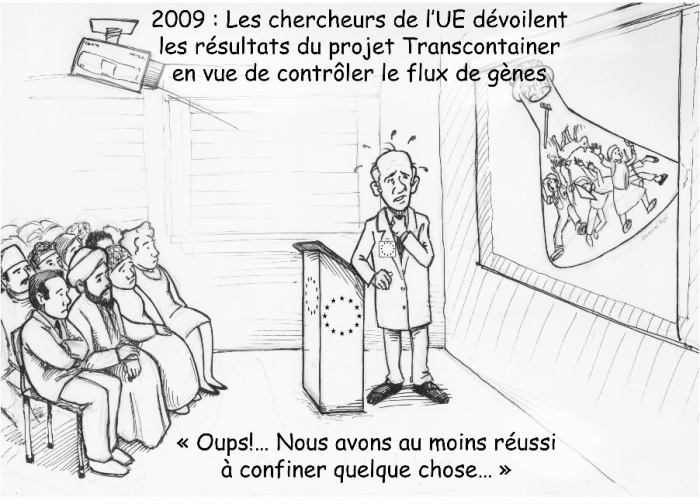
Issue: Under the guise of biosafety, the European Union’s 3-year Transcontainer Project is investing millions of euros in strategies that cannot promise fail-safe containment of transgenes from GM crops, but could nonetheless function as Terminator, posing unacceptable threats to farmers, biodiversity and food sovereignty. Terminator technology – genetic seed sterilization – was initially developed by the multinational seed/agrochemical industry and the US government to maximize seed industry profits by preventing farmers from re-planting harvested seed. Researchers are also developing new techniques to excise transgenes from GM plants at a specific time in the plant’s development, and methods to kill a plant with “conditionally lethal” genes. This new generation of GURTs will shift the burden of trait control to the farmer. Under some scenarios, farmers will be obliged to pay for the privilege of restoring seed fertility every year – a new form of perpetual monopoly for the seed industry.

News Release from the Galapagos National Park re: Planktos

The Galápagos National Park (entity in charge of managing and administering the two protected areas of the Galápagos Archipelago), is concerned with the US Company Planktos and its plans to experiment in waters near the Galápagos Marine Reserve. For this reason the park has been examining data to stop the Planktos experiment, which could affect the fragile ecosystems of the Galápagos Islands, declared a UNESCO World Heritage Site.

Further Reflections on EPO Decision to REVOKE Monsanto's Transgenic Soybean Patent

Further Reflections on EPO Decision to REVOKE Monsanto's Transgenic Soybean Patent
Inglés

Further reflections on EPO's May 3 decision to revoke Monsanto's species-wide soybean patent

ETC Group has been receiving lots of emails and phone calls in the past few days about the defeat of Monsanto's soybean patent one week ago. While most have been congratulatory a few have asked whether this wasn't in fact a hollow victory since the patent challenge was won on technical merits rather than fundamental principles of morality. Will it even affect Monsanto's patent portfolio? One US activist asked:

¡PATENTE REVOCADA! El monopolio de Monsanto anulado en Munich

Más vale tarde que nunca

Munich. La Oficina Europea de Patentes (EPO) puso un alto a la avaricia corporativa de Monsanto el 3 de mayo 2007, al revocar su patente total sobre los frijoles de soya genéticamente modificados (EP0301749), una patente sin precedentes por su increíblemente enorme alcance. El Grupo ETC, organización de la sociedad civil con sede en Canadá, ganó la batalla legal contra Monsanto después de 13 años, contra una patente de especie sobre los frijoles de soya, cuando la EPO sentenció que la patente no era nueva o suficiente (es decir, el paso inventivo argumentado no era lo suficientemente claro o contundente para que un especialista pudiera reproduciro). La demanda contra la patente estuvo respaldada por Greenpeace y por la red europea No Patents on Life. La Dra. Ricarda Steinbrecher de Econexus, con sede en Reino Unido, se unió al equipo contra la patente como experto científico.

We just defeated Monsanto! (or at least their patent!)

We just defeated Monsanto! (or at least their patent!)
Inglés

In the midst of our new fight over geoengineering near the Galapagos, we've got good news over a very old fight with Monsanto... Hope Shand just phoned from Munich to say that the European Patent Office has agreed with ETC's arguments and overturned Monsanto's soybean "species" patent. There is no further appeal!!

Geoengineers to Foul Galapagos Seas-Defying Climate Panel Warning

As the UN's top climate science panel, the IPCC, prepares to criticise the idea of geoengineering, one maverick geoengineering company, Planktos Inc, has announced it is about to dump several tonnes of tiny particles into the waters around the Galapagos Islands, covering an area larger than Puerto Rico. Doing so, they claim, will re-engineer the atmosphere, win them commercial carbon credits and perhaps a shot at the $25 million prize for greenhouse gas reduction put up by Richard Branson. Mainstream scientists are sceptical and environmental and social justice groups are crying foul.

REVOKED!! Monsanto Monopoly Nixed in Munich

but little joy in foiling soy ploy at this late date

Munich – The European Patent Office put the brakes on Monsanto’s over-the-top corporate greed by revoking its species-wide patent on all genetically modified soybeans (EP0301749) – a patent unprecedented in its broad scope. ETC Group, an international civil society organization based in Canada, won its 13-year legal challenge against Monsanto’s species-wide soybean patent when an EPO appeal board ruled that the patent was not new or sufficient (i.e., the invention claimed was not sufficiently described for a skilled person to repeat it). The patent challenge was supported by Greenpeace and “No Patents on Life!” Dr. Ricarda Steinbrecher of UK-based EcoNexus also joined the opposition team in Munich as a scientific expert.

¿Geoingeniería para arruinar los mares de las Islas Galápagos?

Abierto desafío al Panel sobre Cambio Climático de la ONU

Mientras el IPCC (Panel Intergubernamental sobre Cambio Climático) —principal grupo científico de la ONU en el tema— se prepara para criticar el concepto de la geoingeniería, Planktos Inc., una impertinente empresa de geoingeniería, anunció estar lista para descargar varias toneladas de partículas minúsculas en las aguas alrededor de las Islas Galápagos, cubriendo un área más grande que Puerto Rico. La empresa asegura que a partir de ello podrá rediseñar la atmósfera, ganar créditos comerciales de carbono e inclusive obtener el premio de $ 25 millones de dólares por la reducción de gases de invernadero, ofrecido por Richard Branson. Gran cantidad de científicos de primer nivel son escépticos en torno a la geoingeniería y muchos grupos ambientalistas y organizaciones civiles están protestando airadamente por lo que consideran una estupidez.

Patente de Monsanto sobre soya, cuestionada en Munich

La Oficina Europea de Patentes decidirá el futuro de la patente monopólica sobre frijol de soya el 3 de mayo de 2007

l 3 de mayo de 2007, el Grupo ETC (organización internacional de la sociedad civil con sede en Canadá, conocida anteriormente como RAFI) junto con “No Patents on Life!” y Greenpeace continuarán una batalla legal de 13 años contra una de las patentes de biotecnología más tristemente célebres. En una audiencia que tendrá lugar en la Oficina Europea de Patentes, en Munich, organizaciones de la sociedad civil argumentarán que la patente de Monsanto (EP No. 301-749) sobre todas las variedades de soya transgénica —sin precedentes por su rango tan amplio— debe revocarse. “Ninguna patente simboliza la falibilidad del sistema de patentes mejor que la de Monsanto que cubre toda una especie, los frijoles de soya diseñados genéticamente”, dijo Hope Shand de el Grupo ETC. “La patente de Monsanto tiene graves fallas técnicas y es inaceptable del punto de vista moral”, afirmó Shand.

Top Ten Seed Companies 2007

Top Ten Seed Companies 2007
Inglés

In a couple of days Hope Shand from ETC Group will be in court in the European patent Office to challenge Monsanto's Patent on Soy beans - a patent that we have been contesting for 13 years and that originally Monsanto themselves opposed!! You can read more about that here. In the meantime, ETC Group is releasing its new ranking of the world's top 10 seed companies, based on 2006 seed revenues. The list appears below.

Green Revolution 2.0 for Africa?

This time the “silver bullet” has a gun

Issue: Everybody’s trying to jump-start science – and, especially, agricultural science – in Africa. Starting with the G8 meeting in Canada five years ago – and pledges by four of its members to build new centers of scientific excellence in Africa – the Syngenta Foundation, CGIAR, Jeffrey Sachs’s Earth Institute, and now, Google, Gates, and Rockefeller are all pushing new initiatives for the continent. While there is no denying that Africans deserve support in their struggle to address hunger, disease and climate change, science and technology are no “silver bullet” to resolve Africa’s problems. Yet, when the G8 meets this June in Germany they are expected to announce a new research agenda that will again propose scientific solutions to the world’s – and, particularly Africa’s – social problems.

¿Revolución Verde 2.0 para África?

Parece que la “bala de plata” ya tiene un arma

Asunto: En África todo mundo quiere impulsar la ciencia, y especialmente la ciencia agrícola. A partir de la reunión del G8 hace cinco años en Canadá, donde cuatro de sus miembros prometieron construir nuevos centros de excelencia científica, ahora la Fundación Syngenta, el CGIAR, el Jeffrey Sachs Earth Institute, Google, Gates y Rockefeller, están impulsando nuevas iniciativas para el continente. Si bien nadie niega que los africanos necesitan ayuda en su lucha para acabar con el hambre, las enfermedades y el cambio climático, la ciencia y la tecnología no son la “bala de plata” para resolver los problemas de África. Sin embargo, en junio se reunirá el G8 en Alemania, donde se espera el anuncio de una nueva agenda de investigación que propondría, precisamente, soluciones científicas para los problemas sociales del mundo y especialmente de África.

Monsanto's Soybean Monopoly Challenged in Munich

European Patent Office Will Decide Fate of Species-Wide Soybean Patent on 3 May 2007

On 3 May 2007 ETC Group (a Canadian-based international civil society organization - formerly known as RAFI) together with "No Patents on Life!" and Greenpeace will continue a 13-year legal battle against one of biotech's most notorious patents. At an appeal hearing at the European Patent Office in Munich, civil society organizations will argue that Monsanto's patent (European Patent No. 301-749) on all genetically engineered soybeans - unprecedented in its broad scope - must be revoked. "No patent symbolizes the brokenness of the patent system better than Monsanto's species-wide patent on genetically engineered soybeans," said Hope Shand of ETC Group. "Monsanto's patent is both technically flawed and morally unacceptable," said Shand.

5-4-3-2-1! GM Crop Countdown.

5-4-3-2-1! GM Crop Countdown.
Inglés

The biotech industry claims that the global area devoted to GM crops in 2005 was 90 million hectares - or 222 million acres. ETC Group does not endorse or agree with the validity of annual statistics on GM crops compiled by the International Service for the Acquisition of Agri-biotech Applications (ISAAA).

We agree with civil society critics who charge that ISAAA's statistics are inflated and unreliable. However, even using industry-generated statistics, the biotech countdown is revealing. Here are the vital statistics:

News Release: Food Sovereignty or Green Revolution 2.0?

This time the “silver bullet” has a gun

ETC Group released a 16-page review of five new initiatives intended to launch what ETC dubs “Green Revolution 2.0” in Africa. Leading the charge is a plan to construct four Centers of Excellence together with a second initiative called the Alliance for a Green Revolution in Africa (AGRA), funded by the Bill and Melinda Gates Foundation and the Rockefeller Foundation. “The Green Revolution that followed World War II focused on semi-dwarf, high-yielding plant varieties” says Pat Mooney, ETC Group’s Executive Director. “It was a one-size-fits-all, take-it-or-leave-it silver bullet,” Mooney adds, “Africa left it.” In other words, Green Revolution technologies were inappropriate for the needs and resources of African farmers. ETC Group’s communiqué warns that, in Green Revolution 2.0, “big-box” science is being buttressed by a strategy to restructure African agriculture. Although the cornerstone of the new revolution will still be high-tech seeds, the G-8 and private foundations also want continental changes in market structure, intellectual property laws, and seed regulation so that agribusiness suppliers can profitably sell seeds, chemicals, and other inputs to farmers. “Big-box science will be linked to small box suppliers,” Mooney argues, “This time, the silver bullet has a gun.”

Páginas

Suscribirse a Recent content