
Submitted by Ronnie Hall on
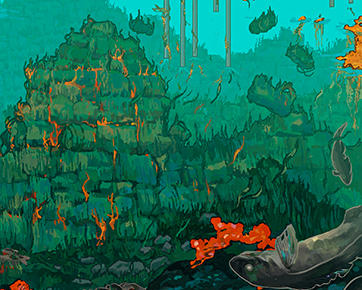
Picture the scene: it’s late 2026 and you’re crossing the Atlantic Ocean. You gaze down at the sea lapping gently at the sides of your ship - but instead of clear seawater, you find that you are surrounded by invasive seaweed, stretching as far as the eye can see, in all directions. You’ve ventured into a vast Sargassum giga-farm, extending from horizon to horizon, covering an area the size of a country.
This is not a sci-fi horror movie – it’s all part of one company’s plan to cultivate colossal amounts of seaweed in the Caribbean sea and the southern Atlantic Ocean, to cash in on polluting industries’ hunger for carbon credits to offset emissions.
Seafields is a UK startup whose entire business model hinges on the claim that by growing enough seaweed, we can absorb enough carbon from the atmosphere to cool the climate. At ETC Group we have discovered, however, that Seafields’ operations are less likely to save the climate and more likely to save the fossil fuel industry, by generating carbon credits so that polluting companies around the globe can claim to ‘offset’ - instead of reduce - their emissions.
Greenwashing on an oceanic scale
Our new report: Farming the Ocean for Carbon Market Profit: Seafields' Faulty Promises in the Caribbean, reveals that Seafields - a band of UK ‘sustainable solutions’ professionals, have a business plan which, if realized, could threaten our ocean’s ecological boundaries, and push us ever closer to planetary tipping points. Riding the wave of carbon-offset-fever and driven by demand from a fossil industry desperate to stay in profit forever, Seafields has experimented with unproven and dangerous geoengineering techniques in the Caribbean, in order to generate offsetting credits.
What is marine geoengineering?
Geoengineering refers to high-risk technologies supposedly intended to slow down or reverse the effects of climate change. In reality, all geoengineering technologies are either highly speculative or have been debunked, and each presents numerous risks that justify their rejection.
According to our allies at the Hands Off Mother Earth Alliance (HOME), the worlds ocean’s are increasingly being targeted for geoengineering technologies, including creating enormous algal blooms (Ocean Fertilization), dumping minerals (Ocean Alkalinity Enhancement), and spraying seawater to ‘brighten’ clouds (Marine Cloud Brightening). These marine geoengineering techniques, if deployed at scale, are projected to require up to 10% of the ocean’s surface. You don’t need to be a scientist to imagine the impacts on ocean ecosystems. Biodiversity on our coastlines would be irreversibly damaged. This would be a further damning blow to coastal communities’ right to food sovereignty.
It is for this reason that marine geoengineering technologies – like ocean fertilization – are currently subjected to a global moratorium. Other technologies are closely monitored and reviewed under the precautionary principle - but this hasn’t stopped Seafields from experimenting anyway, and deploying two controverial techniques - biomass sinking and artificial upwelling.
What does this mean for the people who will be most affected?
Seafields’ slick slogan on its “Sargassum management” webpage - “The new and cost-effective solution for Caribbean Hotels and Governments” reveals a PR campaign focused on Instagram-friendly beaches for affluent tourists. But what about the people who live there?
In the Caribbean, ‘blue economy’ projects like tourism, oil drilling and military activities, already shape peoples’ lives and prospects for the worse. Traditional jobs and ways of life are already under threat from climate change. Communities have a deep and historical knowledge of the ecosystems in the sea and on their coastal lands – but this is being ignored as Global North-owned companies follow a so-called ‘development’ agenda, industrializing coastlines, cultivating seaweed monocultures and extracting resources from the region.
What about the seaweed giga-farm?
Back to Seafields’ plan: to build a Sargassum giga-farm in the southern Atlantic Ocean: an expanse of invasive seaweed covering around 700,000 square kilometers (if you’re finding that hard to picture, it’s about the size of Zambia). Their aim? To “produce enough biomass to compete with oil and phase out fossil-fuel use.”
According to Kaveri Choudhury, geoegineering program manager at ETC Group, it’s part of a troubling model of resource extraction, where companies from the Global North profit from coastal ecosystems and marine spaces in the Global South: “This kind of industrial monoculture seaweed farming has long been rejected by Indigenous Peoples and coastal communities because of the impacts on their livelihoods, and on the ecosystems they care for. Seafields and their partners have already experimented with biomass sinking in waters near Barbados, raising serious concerns about the commercialization of risky and unproven geoengineering technologies in the Global South.”
Seafields’ plan is only part of a growing push from companies and lobbyists to legitimize speculative geoengineering technologies under the guise of ‘research’ or ‘pilot experiments’. All while providing cover for the fossil industry to keep polluting, with the reassurance that we have a Plan B waiting in the wings.
Spoiler alert: there is no Plan B, as Choudhury explains: “We need governments to champion real solutions to tackle climate change and biodiversity loss. Seafields’ activities will only drive us faster towards dangerous planetary tipping points.”
At this point, it’s worth posing the question: is there anything global industry won’t do to avoid phasing out fossil fuels?
Read our report Farming the Ocean for Carbon Market Profit: Seafields' Faulty Promises in the Caribbean at: https://www.etcgroup.org/content/seafields-faulty-promises-caribbean