Recent content

La Suprema Corte de Canadá pisotea los derechos de los agricultores y afirma el monopolio corporativo de Monsanto sobre seres vivos.

Organizaciones de la sociedad civil y de agricultores en todo el mundo reaccionaron con indignación ante la decisión por cinco votos contra cuatro que tomó hoy (21.04.2004) la Suprema Corte de Canadá, afirmando el derecho de Monsanto a demandar a los agricultores que tengan cultivos con genes transgénicos en sus parcelas, sea que los hayan elegido o que se hayan contaminado. El gigante genético Monsanto acusó a los agricultores de Saskatchewan, Percy y Louise Schmeiser, de violar la patente de la compañía sobre canola transgénica. Percy y Louise no querían las semillas de canola transgénica que invadieron su propiedad, ni trataron de aprovecharse del carácter tolerante al herbicida que tiene la semilla transgénica (o sea, ellos no utilizaron el herbicida Roundup en sus cultivos). De todos modos, Monsanto los demandó por violación a su patente y exigió una parte de sus ingresos. Con gran valor, los Schmeiser libraron durante siete años una batalla legal contra Monsanto que terminó en la Suprema Corte de Justicia de Canadá.

Canada's Supreme Court Rules on 'David & Goliath' Friday: Tell Monsanto Where to Go!

Letter warnings for Monsanto: There are 5 million Percy Schmeisers

Bees, beetles and blowing prairie winds can carry Monsanto’s genetically-modified canola a good 26 kilometers – and a whole lot farther if the transgenic seed or pollen hitches a ride on passing trucks, trains or trousers. After eight summers in Canada’s West, GM canola has earned the dubious status of a major weed – a common sight in fields, boulevards and cemeteries – and even backyard gardens. "Canola can winter over for 8 years," says ETC Group’s Pat Mooney in the NGO’s Winnipeg headquarters, "meaning GM pollen has probably travelled a minimum of 200 km since Monsanto first commercialized its patented seed in 1996." Which is why, Mooney reasons, just about everyone on the prairies has a direct, personal interest in the May 21st Supreme Court decision. Gene Giant Monsanto has accused Saskatchewan farmers Percy and Louise Schmeiser of illegally growing the company’s canola. "It’s not just farmers," insists Mooney. "There are about 5 million Percy Schmeisers out here [roughly the population of Canada’s three prairie provinces]. For all any of us know, we could have Monsanto’s canola in our window boxes."

La decisión de la Suprema corte de Justicia de Canadá sobre 'David y Goliat': Dígale a Monsanto a dónde irse

Cartas de advertencia para Monsanto: Hay 5 millones de Percys Schmeisers

Las abejas, escarabajos y vientos de las paraderas pueden transportar la canola genéticamente modificada de Monsanto un mínimo de 26 kilómetros -y mucho más si la semilla o el polen transgénico se van de polizones en los camiones que pasan, en los trenes o en la ropa de la gente. Después de ocho veranos en el oeste de Canadá, la canola transgénica ha adquirido la dudosa fama de ser una maleza importante -se le ve comúnmente en los campos, avenidas y cementerios e incluso en los jardines de las casas. "La canola puede invernar hasta ocho años", dice Pat Mooney del Grupo ETC desde la sede de esta organización en Winnipeg, Canadá. "Eso significa que el polen transgénico probablemente viajó un mínimo de 200 kilómetros desde que Monsanto comenzó a vender su semilla patentada en 1996." Por esta razón, explica Pat Mooney, la decisión del 21 de mayo de la Suprema Corte de Justicia, nos afecta a todos, y personalmente a los que viven en el campo. El gigante genético Monsanto acusó a los agricultores de Saskatchewan, Percy y Louise Schmeiser, de cultivar ilegalmente la canola patentada de la compañía. "Pero no se sólo trata de los agricultores", insiste Mooney. "Hay por lo menos 5 millones de Percy Schmeisers [prácticamente la población de las tres provincias de las pradera de Canadá]. Pues cualquiera de nosotros sabemos que la canola de Monsanto podría estar hasta en las macetas de nuestras ventanas."

Tell Monsanto Where To Go!

Saskatchewan farmers Percy and Louise Schmeiser fought Monsanto all the way to the Canadian Supreme Court when the Gene Giant accused them of violating Monsanto's patent on GM canola (oilseed rape). Percy and Louise did not want GM seeds on their property and they did not try to benefit from the herbicide-tolerant trait in the GM seed (that is, they didn't spray Roundup weedkiller). Yet, Monsanto came onto their land without permission, dug around to establish that GM canola had contaminated the Schmeisers' farm, and then blamed the family for the company's failure to control its own technology. GM canola pollen has been shown to travel as much as 26 kilometers (16.2 miles). Monsanto has been selling GM canola since 1996. Canola seed can survive in the soil for eight or more years. GM contamination can spread from fields to boulevards to cemeteries and home gardens. With the help of prairie winds and bees, GM seed planted in a field eight years ago could have hitchhiked more than 208 km. Today, GM canola is a major weed pest on the Canadian prairies.

Patentar genes e investigación es hipotecar el futuro

Recientemente, el Centro de Investigación y Estudios Avanzados (Cinvestav) del Instituto Politécnico Nacional anunció la puesta en marcha del Laboratorio Nacional de Genómica para la Diversidad Vegetal y Microbiana. Los gigantes de la biotecnología "financian" proyectos de instituciones de interés público porque les permite acceder de manera cómoda y barata al germoplasma de los cultivos en diferentes países, utilizando la infraestructura, la formación pública y el conocimiento del medio de los investigadores nacionales, para luego aplicarlo en sus propios productos comerciales y, si viene al caso, patentar sus genes para el lucro de sus empresas.

Las aguas turbulentas de la nanotecnología.

Las últimas noticias sobre la toxicidad de las nano partículas advierten del daño cerebral en especies acuáticas.

Un nuevo estudio revela que las "buckyballs", moléculas diseñadas de carbono, ocasionan daño cerebral en los peces. Esta es una evidencia más que demuestra que las nano partículas manufacturadas son dañinas para la ecología y para la salud. El reporte científico al que nos referimos en este genotipo, aún inédito, es el primero que hace un simulacro de lo que podría pasar cuando las nano partículas se liberen al ambiente.

Nano's Troubled Waters: Latest toxic warning shows nanoparticles cause brain damage in aquatic species and highlights need for a moratorium on the release of new nanomaterials

A new study revealing that engineered carbon molecules known as "buckyballs" cause brain damage in fish is one more brick in the wall of evidence suggesting that manufactured nanoparticles are harmful to the environment and to health.

Jazzing Up Jasmine: Atomically Modified Rice in Asia?

A nanotech research initiative in Thailand aims to atomically modify the characteristics of local rice varieties — including the country's famous jasmine rice — and to circumvent the controversy over Genetically Modified Organisms (GMOs). Nanobiotech takes agriculture from the battleground of GMOs to the brave new world of Atomically Modified Organisms (AMOs).

In January 2004, Bangkok Post reported on a three-year research project at Chiang Mai University's nuclear physics laboratory,(1) funded by the National Research Council of Thailand, to atomically-modify rice. The research involves drilling a nano-sized hole (a nanometer is one-billionth of a meter) through the wall and membrane of a rice cell in order to insert a nitrogen atom. The hole is drilled using a particle beam (a stream of fast-moving particles, not unlike a lightening bolt) and the nitrogen atom is shot through the hole to stimulate rearrangement of the rice's DNA.

Jugando a ser dios en Galápagos

J. Craig Venter, señor de la genómica se lanza a una expedición global para recolectar diversidad microbiana y construir nuevas formas de vida

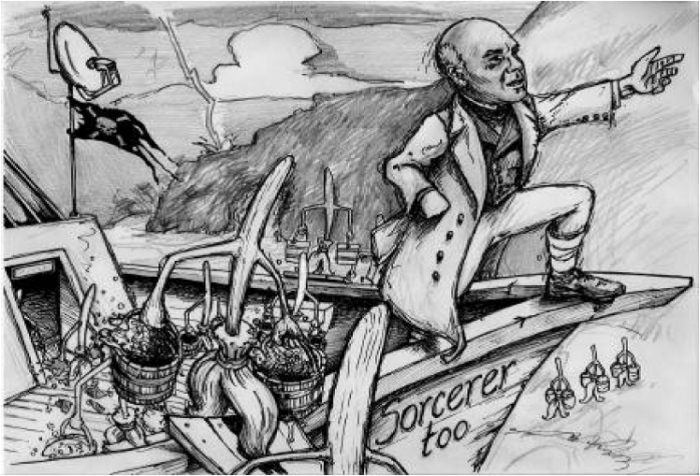
J. Craig Venter, el brujo científico que recientemente creó un organismo vivo único, a partir de cero, en pocos días; está buscando ganancias fáciles en los ecosistemas marinos ricos en biodiversidad de las Islas Galápagos. Desde su yate"The Sorcerer II", Venter navega alrededor del globo recolectando diversidad microbiana cada 200 millas, de los mares y costas ricos en genes. El barco de Venter ya tomó muestras del Mar de los Sargazos, en México, Costa Rica, Panamá, Ecuador y Chile.

Playing God in the Galapagos

J. Craig Venter, the genomics mogul and scientific wizard who recently created a unique living organism from scratch in a matter of days, is searching for pay-dirt in the biodiversity-rich Galapagos Islands. From his 95-ft. yacht, Sorcerer II, Venter is hop-scotching around the globe collecting microbial diversity from gene-rich seas and shores every 200 miles.(1) Venter's ship has already sampled in the Sargasso Sea (North Atlantic), Mexico, Costa Rica, Panama, Ecuador (Galapagos), Chile and is now en route to French Polynesia (Tahiti, Bora Bora, etc.).

Playing God in the Galapagos

J. Craig Venter, Master and Commander of Genomics, on Global Expedition to Collect Microbial Diversity for Engineering Life

The ETC Group releases a new Communiqué today (11.02.2004) that focuses on J. Craig Venter’s controversial ocean expedition that is circumnavigating the globe to collect microbial diversity from gene-rich seas and shores every 200 miles.

J. Craig Venter, the genomics mogul and scientific wizard who recently created a unique living organism from scratch in a matter of days, is searching for pay-dirt in biodiversity-rich marine environments around the world. Venter’s yacht, the Sorcerer II, is now steaming toward the South Pacific after collecting land and marine microbes from Maine to Mexico, Panama, Chile, and — most recently — on Ecuador’s famous Galapagos Islands.

US-Latin Accord Undermines Biosafety Meeting In Malaysia

As negotiations come to a head in Kuala Lumpur at the first meeting of the Biosafety Protocol of the UN Convention on Biological Diversity (CBD) the United States along with Canada and a few Latin American states seem poised to render the 86-nation agreement irrelevant. News earlier this week that the Argentine Government has offered to collect taxes from its GM soybean farmers in lieu of royalty payments has stunned many delegations attending the meeting in the Malaysian capital.

Argentina anuncia que subsidiará a Monsanto

Mientras las negociaciones alcanzan un punto crucial en Kuala Lumpur durante la primera reunión del Protocolo de Bioseguridad del Convenio de Diversidad Biológica (CDB) de las Naciones Unidas, Estados Unidos, junto con Canadá y algunos países latinoamericanos se preparan para echar a la basura el acuerdo que tienen 86 naciones. Por otro lado, el gobierno de Argentina ofreció colectar impuestos de sus productores de frijol de soya como sustituto del pago de regalías desconcertando a muchas delegaciones que asistieron a la reunión en la capital malaya.

Itty-bitty Ethics: Bioethicists see quantum plots in nanotech concern...and quantum bucks in buckyball brouhaha?

In a paper released 28th January 2004, five University of Toronto (UT) ethicists accuse Prince Charles of "fear-mongering" and ETC Group of condemning poor nations to exports of "bananas and t-shirts." The authors speak enthusiastically about the potential of nanotechnology to improve conditions in the developing world and they express dismay that, in their view, "commentators" are now focusing primarily on risks instead of benefits. ETC Group responds.

BioPirates of the South China Sea: Captain Hook Awards Ceremony 2004

Hook meets COPs at the UN's Biodiversity Convention in Malaysia Friday the 13th Awards for Outstanding Malchievements

The Coalition Against Biopiracy (CAB) will present its highly un-coveted Captain Hook Awards – for infamous and outstanding malchievements in biopiracy – at the Biodiversity Convention (CBD) in Kuala Lumpur, Malaysia, Friday the 13th of February 2004. This is the third Global Biopiracy Awards ceremony since the Captain Hook awards were established in 1995. The previous awards were given out in ceremonies at the sixth meeting of the CBD (COP 6) in The Hague in 2002 and at the CBD's fifth meeting in Nairobi in 2000 (COP 5). The Coalition Against Biopiracy emphasizes that the Captain Hook Awards are a collaborative effort, made possible by the vigilance and analysis of many civil society and peoples’ movements around the world. This year, for the first time, the public was invited to make nominations by submitting claims along with full documentation to the CAB's web site at www.captainhookawards.org.

Oligopolios 2003: Control y nuevas tecnologías

Según datos del Banco Mundial, para 2003 se mantuvo la tendencia que inició con el nuevo milenio: de las cien mayores economías del planeta, 51 son corporaciones trasnacionales y 49 son países. Según su producto interno bruto (PIB), los países que encabezan la lista son: Estados Unidos, Japón, Alemania, Reino Unido, Francia, China, Italia, Canadá, España, México, India, Corea, Brasil, Holanda, Australia, Rusia, Suiza y Bélgica. Sigue la cadena de supermercados Wal-Mart, con ventas por valor de 246 mil 525 millones de dólares durante 2002. Es mayor que el PIB de Suecia, Austria o Noruega. Luego se encuentran General Motors, Exxon Mobil, Shell, BP, Ford, Daimler Chrysler, Toyota, General Electric, Mitsubishi, Citigroup, ING Group, IBM y otras. Las petroleras y fabricantes de automóviles han estado por décadas entre las mayores economías del planeta. Se sumaron hace años las firmas de electrónica y los grandes grupos financieros, como aseguradoras y bancos. Desde comienzos de siglo, Wal-Mart se ha mantenido como la empresa más grande del planeta, rebasando a las anteriores. Otros megasupermercados escalan rápidamente: Carrefour, SA, y Royal Ahold tienen volúmenes de venta mayores que el PIB de países como Perú y Nueva Zelandia. Le siguen de cerca procesadoras de alimentos y bebidas como Nestlé y Vivendi e hicieron su entrada a las cien mayores economías globales las trasnacionales farmacéuticas, con Merck & Co en el puesto 99, según las ventas de 2002. Durante 2003, la fusión de los gigantes farmacéuticos Pfizer y Pharmacia aseguró un puesto mucho más arriba en la escala, colocándose 40 por ciento arriba de Merck en volumen de ventas.

Páginas

Suscribirse a Recent content