Recent content

Frequently Unasked Questions About The International Undertaking On Plant Genetic Resources

In Search of Common Ground

Negotiations on the revised International Undertaking at FAO will profoundly affect the world's ability to respond to climate change. Failure will lead to a rapid reduction in the exchange of plant breeding stocks between countries and institutions. Agricultural research will be severely damaged. RAFI looks at the major issues and controversies under discussion in the final rounds of negotiations.

ETC Group Censored!

ETC Group Censored! The 25th Anniversary Edition of the Top Censored Stories of the Year, 2001 features critical social issues that have been under-reported or ignored in the mainstream media. ETC Group is the recipient of two Project Censored awards, and both are featured in this book. Biopiracy in Chiapas and the efforts of local indigenous peoples to defeat the US-government funded International Cooperative Biodiversity Group (ICBG-Maya) is one of the award-winning issues identified by Project Censored in 2000.

La tormenta de "El Nuña"

Grupos andinos protestan por la patente del frijol nuña

Testimonios desde el tribunal:

"El frijol nuña es parte de la herencia andina. Es nuestro tesoro. Que una empresa patente una cruza de nuña, reclamando el mérito de haber inventado esta variedad de frijol como novedad mundial, es inmoral y viola los derechos de todos los grupos indígenas", dijo Elías Carreño, coordinador de la campaña "Parar la biopiratería en los Andes", campaña que impulsa la Asociación Kechua-Aymara para la Conservación de la Naturaleza y el Desarrollo Sostenible, ANDES.

Apoyo a Carta al Congreso de la Unión

Por el reconocimiento de los Derechos y Cultura Indígenas en México.

La siguiente carta abierta, enviada el 22/03/2001 al Congreso de la Unión de los Estados Unidos Mexicanos, recibió al momento el apoyo de 23 premios "Nobel Alternativos" y más de 330 firmas de organizaciones y personas en 48 países en los cinco continentes, a nombre de 144 organizaciones ecologistas, sociales y sindicales, así como miembros de 34 universidades.

Open Letter to Mexican Congress

RAFI requests signatories to an open letter in support of the constitutional recognition of indigenous rights in Mexico that has been sent to the Mexican Congress. Full text below:

Dear Friends,

Today, an open letter in support of the constitutional recognition of indigenous rights in Mexico has been sent to the Mexican Congress, which is currently discussing this issue, undersigned by 14 recipients of the Right Livelihood Award (sometimes referred to as the 'Alternative Nobel Prize') and the Goldman Prize.

The letter was published in a full-page presentation in La Jornada on Thursday, March 22,2001 on page 14: http://www.jornada.unam.mx/2001/mar01/010322/014n1pol.html.

...

Carta abierta al Congreso de la Unión, México

Por el reconocimiento de los derechos indígenas

Estimados amigos y amigas,

En el día de ayer, una carta abierta de 14 "premios Nobel alternativos" (Premio (Right Livelihood y Premio Golman) fue entregada al Congreso de la Unión, México, pidiendo el reconocimiento constitucional de los derechos y cultura indígenas, que está actualmente debatiendo el tema.

También fue reseñada en un extenso artículo del diario La Jornada, el 22/3/20001.

http://www.jornada.unam.mx/2001/mar01/010322/014n1pol.html
...

Bracing for 'El Nuña'

Andean Groups Hopping Mad About Popping-Bean Patent

Tales from a Tribunal: 'The nuña bean is part of the Andean heritage. It is our treasure. For a company to patent a nuña cross, claiming the 'bean-nut popping bean' as an 'invention' with absolute world novelty is immoral and violates the rights of all indigenous groups,' said Elias Carreno, Coordinator of the 'Stop Biopiracy in the Andes' Campaign of the Associaci n Kechua-Aymara for Sustainable Livelihoods, ANDES (translated from Spanish).

Indigenous elders from six Andean communities that grow nuna beans met in late February for a traditional Quechua 'tribunal' to deliberate on US Patent No. 6,040,503 on the 'bean-nut popping bean' awarded to a US food processor, Appropriate Engineering and Manufacturing. The popping bean trait is found only in the Andean nuna bean, which the inventors claim in their patent. After hearing testimony from expert witnesses, the tribunal rendered their decision. Their verdict was unflinching in its criticism of intellectual property monopolies that are predatory on the knowledge, rights and resources of indigenous people.

New Terminator Patent Goes to Syngenta

Wake-Up Call for CBD's Scientific Body Meeting in Montreal

World's Largest Agrochemical and Seed Enterprise Holds Growing Arsenal of Terminator and Traitor Technologies

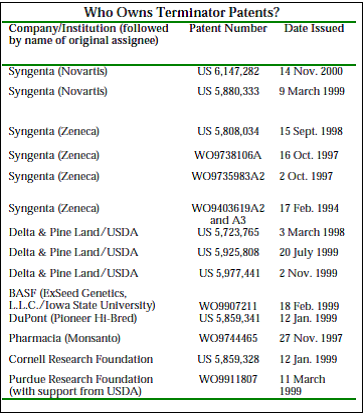
Syngenta, the world's largest agribusiness firm, was formed on 13 November 2000 with the merger of AstraZeneca and Novartis. The next day the company won its newest Terminator patent, US Patent 6,147,282, 'Method of controlling the fertility of a plant.' (The patent was issued to Novartis - but the company's intellectual property goes to Syngenta.) With pro forma 1999 sales of US $7 billion, Syngenta is the world's largest agrochemical enterprise, and the third largest seed corporation.

2001: A Seed Odyssey

RAFI's Annual Update on Terminator and Traitor

Terminator patent portfolios are changing hands because the Gene Giants are consolidating, spinning off, and selling agbiotech interests. New patents describing genetically modified plants with weakened immune systems that depend on the application of a chemical to regain their natural defenses against pests and disease are the most troubling examples of Traitor technology to date.

Actualización anual de RAFI sobre la tecnología Terminator y Traitor. 2001: La odisea de las semillas

Nuevas patentes que describen plantas transgénicas con sistemas inmunológicos debilitados, que dependen de la aplicación de insumos químicos para restaurar su resistencia natural a enferemdades y plagas, son algunos de los ejemplos más perturbadores de la tecnología Terminator en estos días, mientras los gigantes genéticos están fusionando, desmembrando y rematando constantemente sus activos en agrobiotecnología y se vuelve imposible identificarlos.

ETC Century: Erosion, Technological Transformation, and Corporate Concentration in the 21st Century

This issue {1999:1-2 [2001]} of Development Dialogue, published by the Dag Hammarskjold Foundation, was authored by Pat Mooney. The ETC Century discusses trends in technological transformation, environmental and cultural erosion, and the re-organization of economic power into the hands of high-tech global oligopolies. This publication is 128 pages.

RAFI and RAFI-USA Announce Plans of Name Change for Globally-focused RAFI

Twenty-three years old, one of the world's most experienced biodiversity/biotech advocacy organizations is broadening its focus and changing its name, the directors of RAFI and of RAFI-USA announced today.

Long history: RAFI and RAFI-USA staff have been working together for over 20 years. Work on agricultural genetic resources that began under the mandate of the International Coalition for Development Action (ICDA), a Brussels-based civil society organization (CSO), in 1977 quickly merged with similar work under the auspices of the Rural Advancement Fund in the southern United States and led to the formation of the Rural Advancement Foundation International (RAFI) as a Netherlands incorporated CSO in 1985. Although the international work began to be known as RAFI, the work was still under the auspices of the Rural Advancement Fund which fully supported the work through its staffing and fundraising efforts.

Enola Bean Patent Challenged

'This patent has caused great economic hardship for farmers in northern Mexico, and we welcome attempts to overturn it,' said Miguel Tachna Felix, spokesman for the Agricultural Association of Rio Fuerte in Sinaloa, Mexico which represents 22,000 farmers in northern Mexico. Felix is referring to a legal challenge of a US patent on a yellow bean of Mexican origin.

Le Débat des semences : Volume 1

Solutions politiques pour les ressources génétiques (Un Brevet pour la vie revisité)

Le Débat des semences met les lecteurs au courant de ce qui a changé — sur le plan scientifique, politique et environnemental — depuis la publication en 1994 de Un Brevet pour la vie, un ouvrage qui a fait sa marque.

Le volume I offre aux décideurs une description claire des faits, des luttes et des discussions concernant la propriété, la conservation et l’échange des ressources génétiques. Il apprendra aux lecteurs qui abordent ces questions pour la première fois pourquoi le matériel génétique est important et pourquoi il fait l’objet de négociations commerciales intenses. Le lecteur comprendra mieux les enjeux relatifs à la propriété intellectuelle et à la sécurité aux plans national et international.

Biotech's 'Generation 3'

What's in the GM pipeline? How will it work? Who will control it? What does it mean for farmers, consumers and policymakers?

Biotech's 3rd Generation refers to products that will offer perceived health, nutrition or lifestyle benefits for consumers. The lure of a technologically-integrated $15 trillion system will attract whole new corporate configurations. The Gene Giants may slip down the food chain when the food & beverage industry or the grocery retailers buy into Generation 3.

La "generación 3" de la Biotecnología

RAFI acaba de publicar un nuevo número de su boletín informativo 'RAFI Communique', sobre la 'Generación 3' de productos biotecnológicos. Adjuntamos un breve resumen de los puntos principales contenidos en este informe de 18 páginas sobre las tendencias de esta tercera generación (productos manipulados genéticamente que ofrecen aparentes beneficios nutricionales y para la salud de los consumidores). Se puede obtener el texto completo en http://www.etcgroup.org.

Calendario de Calamidades - 2000

La "Generación 1" de la biotecnología: -los afanes de una juventud desperdiciada

Presentamos a continuación un calendario (versión "mejor reír que llorar?"), en compilación de RAFI, sobre algunos de los desastres científicos, políticos e informativos que han golpeado a la industria agrobiotecnológica desde que se firmó el Protocolo de Bioseguridad, en enero del 2000.

Comiendo con el enemigo

Al tiempo que los alimentos transgénicos fueron lanzados al mercado como "la solución al hambre en el mundo", la primera generación de transgénicos nos planteó la pregunta de si quienes hacían este anuncio pensaban que el mundo se podría alimentar de agrotóxicos. En efecto, pese a pomposas declaraciones tanto de la industria biotecnológica como de algunas academias de ciencias, más de 70 por ciento de los cultivos transgénicos sembrados hasta este año fueron modificados para ser resistentes a químicos de las propias compañías, aumentando el nivel de estos químicos tanto en el ambiente como en los residuos que permanecen en los alimentos. Más de 25 por ciento restante han sido "cultivos-insecticidas", manipulados usando hasta límites inimaginables algunas pocas cepas de una sola bacteria -el bacillus thuringiensis o Bt- lo cual, como era lógico, produjo en poco tiempo resistencia en los insectos que se suponía iba a combatir, creando necesidad de más químicos en lugar de lo contrario, como prometían las multinacionales que lo comercializan.

Páginas

Suscribirse a Recent content