Recent content

¿De quién es la naturaleza?

Nuevo informe sobre la concentración corporativa, la transformación de la naturaleza en mercancía y la resistencia global anclada en la Soberanía Alimentaria

El Grupo ETC publicó su informe de 55 páginas ¿De quién es la naturaleza? acerca de la concentración del poder de las corporaciones sobre los alimentos, la actividad agrícola, la salud y la estrategia en marcha para volver mercancía todos los recursos naturales que quedan sobre el planeta.

En un mundo en que las investigaciones de mercado son cada vez más costosas y secretas, el Grupo ETC da nombres, revela el reparto de los mercados y brinda información sobre las 10 principales industrias del mundo en todos los ramos que atraviesan la cadena alimentaria controlada por las corporaciones. No todas las compañías identificadas en el informe del Grupo ETC son las más famosas en su sector, pero colectivamente controlan una porción gigantesca de los productos que encontramos en la agricultura industrial, en nuestros refrigeradores y nuestros botiquines.

News Release: Who Owns Nature?

New report warns of corporate concentration, commodification of nature; highlights global resistance grounded in "Food Sovereignty"

ETC Group released a 48-page report, "Who Owns Nature?" on corporate concentration in commercial food, farming, health and the strategic push to commodify the planet's remaining natural resources.

In a world where market research is becoming increasingly proprietary and pricey, ETC Group's report names names, discloses market share and provides top 10 industry rankings up and down the corporate food chain. Not all the corporations identified in ETC Group's new report are household names, but collectively they control a staggering share of the commercial products found on industrial farms, in our refrigerators and medicine cabinets.

Who Owns Nature?

Corporate Power and the Final Frontier in the Commodification of Life

In this 100th issue of the ETC Communiqué we update Oligopoly, Inc. – our ongoing series tracking corporate concentration in the life industry. We also analyze the past three decades of agribusiness efforts to monopolize the 24% of living nature that has been commodified, and expose a new strategy to capture the remaining three-quarters that has, until now, remained beyond the market economy.

The New Enclosures of the Mind

Article for Heinrich Boell Foundation

You can fool some of the people all of the time; and, all of the people some of the time; but, you can't fool all of the people all of the time... However, you may be able to persuade enough of the people to monitor everyone all of the time.

Over 30 years ago, Oxford ethologist, Dr. Richard Dawkins, took sabbatical leave to write The Selfish Gene, one of the most disturbing books in a time of many disturbing books. Dawkins espoused the theory that human evolution is nurtured by numerous forces -- the gene, or DNA -- being only one. Human beings, Dawkins speculated, could evolve cultural memes capable of Darwinian replication. It was an outlandish concept without "coat tails" -- at least that chapter of his book didn't attract many followers.

ETC Group would have given the idea of cultural memetics a pass were it not for a high-level meeting of US government officials, scientists, and industry held in Washington three months after 9/11 that made research into cultural memetics a priority. Then, two years later, a book by Britain's much-respected Astronomer Royal brought us back to memetics with his concern that it may be possible to medicate social attitudes and manipulate human nature.

But, the most compelling reason to track this potentiality is because it makes sense. If, as the UN University‘s 2005 State of the Future Report suggest, we are entering the era of the Massively Destructive Individual - where anyone, anywhere could be devastatingly violent, using anything - then massive surveillance is, at best, a partial response. Aggressive surveillance will elicit a massive social reaction. Better than surveillance is surrender. If society can be cajoled into surrendering its information than the likelihood of a successful defense increases. Better still, if society can be convinced to surrender control over its own actions, then the world's dominating corporate/government partnership can sleep at night. Civil society needs to dissect the logic and the feasibility of all this...

Hanging in Hong Kong with the Syn Bio Crowd

Hanging in Hong Kong with the Syn Bio Crowd
Inglés

Apparently in some places they call Hong Kong "Disneyland". What better place than among the sci-fitowers of this gotham-city landscape for the brave new pioneers of Synthetic Biology to gather, plan and celebrate the next stage of artificial life. For the next few days Synthetic Biology 4.0, the fourth global congress of syn bio leaders, will be meeting at Hong Kong's University of Science and Technology to discuss synthetic organisms, whole genome construction, next generation biofuels and all manner of biohackery.

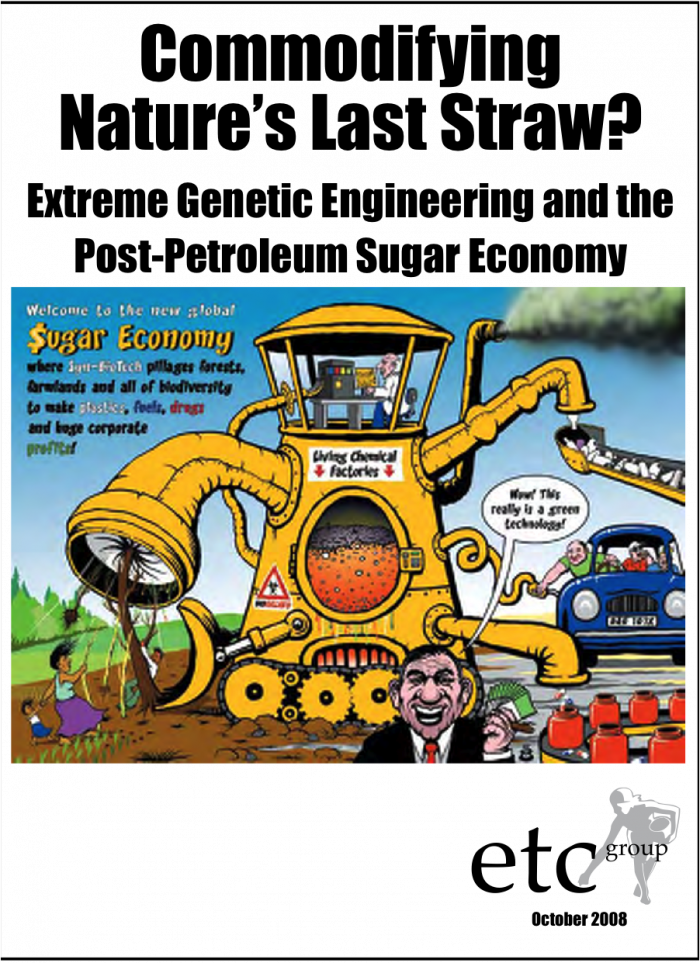
Commodifying Nature's Last Straw?

Extreme Genetic Engineering and the Post-Petroleum Sugar Economy

Peak oil, skyrocketing fuel costs and climate crisis are driving corporate enthusiasm for a “biological engineering revolution” that some predict will dramatically transform industrial production of food, energy, materials, medicine and all of nature. Advocates of converging technologies promise a greener, cleaner post-petroleum future where the production of economically important compounds depends not on fossil fuels – but on biological manufacturing platforms fueled by plant sugars. It may sound sweet and clean, but the so-called “sugar economy” will also be the catalyst for a corporate grab on all plant matter – and destruction of biodiversity on a massive scale.

The Last Straw?

As Extreme Genetic Engineers Gather in Hong Kong, Critics Warn of Corporate Grab on Plant Life: SynBio 4.0 = SynBio-4-profit

Synthetic biologists, a brave new breed of science entrepreneurs who engineer life-forms from scratch, will hold their largest-ever global gathering in Hong Kong, October 10-12 2008, known as "Synthetic Biology 4.0." Although most people have never heard of synthetic biology, it's moving full speed ahead fueled by giant agribusiness, energy and chemical corporations with little debate about who will control the technology, how it will be regulated (or not) and despite grave concerns surrounding the safety and security risks of designer organisms. Corporate investors/partners include BP, Chevron, Shell, Virgin Fuels, DuPont, Microsoft, Cargill and Archer Daniels Midland.

Plastic Plants

Plastic Plants
Inglés


Henry Ford dreamed of making plastic cars out of soy. Now Dow, DuPont and other chemical giants are also dreaming of a ‘green’ future. But, as Jim Thomas argues, bioplastic is not the eco-solution it’s cracked up to be.

Article from New Internationalist Magazine September 2008 issue - available online here

Cómo volver mercancía hasta la última brizna de hierba

Ingenería genética extrema y la economía post-petrolera del azúcar

Debido a la crisis del petróleo, a la escalada en los precios de los combustibles y a la crisis del clima, las corporaciones redirigen su entusiasmo hacia una “revolución de la ingeniería biológica” que algunos auguran transformará dramáticamente la producción industrial de alimentos, energía, materias primas, medicina y la naturaleza entera. Los entusiastas de las tecnologías convergentes prometen una era post-petróleo más verde y limpia, donde la producción de compuestos importantes para la economía no dependerá de los combustibles fósiles, sino de la manufactura de plataformas biológicas alimentadas por azúcares vegetales. Tal vez suene dulce y limpio, pero la llamada “economía del azúcar” también catalizará la voracidad de las corporaciones por toda la materia vegetal —y con ello, la destrucción de la biodiversidad a una escala masiva.

Los nuevos confinamientos de la mente

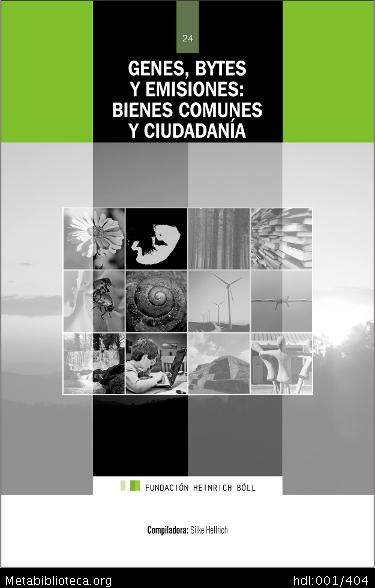
Capítulo para el libro “Bienes comunes y ciudadanía”

Se puede engañar a algunos todo el tiempo y a todos parte del tiempo, pero no se puede engañar a todos todo el tiempo… Sin embargo, se puede convencer a un número suficiente de gente para monitorearnos a todos, todo el tiempo.

En el contexto de los nuevos asaltos a los bienes comunes, las tecnologías de punta (como la nanotecnología, la genómica, la biología sintética, robótica e informática) ocupan un papel importante, ya que proveen herramientas instrumentales
para nuevas formas de despojo. Separadas, esas tecnologías tienen particularidades y problemas propios, pero los aspectos más peligrosos están en su sinergia y convergencia y el aprovechamiento de éstas por parte de las élites. Tenemos que analizar esto con sumo cuidado, no sólo considerando los probables impactos al ambiente, a la salud y a las economías, (que ciertamente son significativos), sino estimando que estas nuevas y poderosas tecnologías, especialmente por ser desarrolladas en el contexto de sociedades injustas, habilitan nuevas formas de control, vigilancia y dominio, así como los intentos por eliminar la disidencia social.

Technofixes: Climate Solution Or Corporate Scam?

Technofixes: Climate Solution Or Corporate Scam?
Inglés

Can science save the planet or should we avoid putting our faith in high-tech fixes to deliver us from the ecological mess we‘ve made? Jim Thomas and Paul Fitzgerald push each other’s buttons.

Read the debate here in the latest issue of New Internationalist Magazine: http://www.newint.org/features/special/2008/08/01/technofixes/

TechReckoning: Flask-Grown Flesh

TechReckoning: Flask-Grown Flesh
Inglés

Written for The Ecologist - 20/07/2008

If radical vegan Ingrid Newkirk has her way, the nouvelle cuisine on vegetarian menus in five years time may be a big juicy steak.

Newkirk, founder and president of People for the Ethical Treatment of Animals (PETA), has offered a $1 million prize to whoever can scale-up stem cell techniques that grow edible animal tissue – so called lab-grown meat – for a mass market.

Pruebas personales de ADN y el mito de la medicina personalizada

Kits para muestras de saliva, chips SNP y genómica humana

Reporte especial sobre genómica humana

Pruebas personales de ADN y el mito de la medicina personalizada:
kits para muestras de saliva, chips SNP y genómica humana

El tema de este reporte es la industria de las pruebas genéticas personales, que promete a los consumidores darles una individual para mantener la salud así como un “horóscopo” basado en la genética para predecir enfermedades futuras.

Pat Mooney's OP-ED in Toronto Star

Pat Mooney's OP-ED in Toronto Star
Inglés

Biofuels fuel global food crisis
Toronto Star/star.com July 08, 2008
PAT MOONEY

As G8 leaders meet this week in Japan, their ears will still be ringing from the bombshell dropped last week in a leaked World Bank report declaring that biofuels have forced global food prices up by 75 per cent, far higher than previously estimated.

Pat Mooney's Testimony on Biofuels to Canadian Senate

Pat Mooney's Testimony on Biofuels to Canadian Senate
Inglés

Testimony of Pat Mooney

Executive Director of ETC Group

Before the Standing Committee on Energy, the Environment and Natural Resources-regarding Bill C-33 (the "Biofuels Bill")

Senate of Canada

Wednesday, June 25, 2008

Thank you. I will begin by confessing that I am not an expert on biofuels. I feel as though my life has been hijacked by biofuels over the last few months.

Wrong Response to Food Crisis

Wrong Response to Food Crisis
Inglés

During the United Nations High-Level Conference on World Food Security, Climate Change and Bioenergy, Rome-based U.N. agencies announced yesterday that a new partnership was struck between the Alliance for a Green Revolution in Africa (AGRA), the Food and Agriculture Organization of the United Nations (FAO), the International Fund for Agricultural Development (IFAD), and the World Food Programme (WFP).

Páginas

Suscribirse a Recent content