Recent content

Enclosures of the Mind: Intellectual Monopolies

A Resource Kit on Community Knowledge, Biodiversity, and Intellectual Property Rights

An introduction to intellectual property monopolies. The 70 page booklet produced by IDRC in 1996 is designed as an information and advocacy tool for civil society and policymakers in response to two new, legally binding international agreements: the Convention on Biological Diversity and the World Trade Organization's Trade Related Intellectual Property Agreement (WTO/TRIPs).

1996 Biopiracy Update

Bolivian Quinoa Claimed in US Patents

"Biopiracy" -- a term coined by RAFI in 1994 - refers to the use of intellectual property laws to gain exclusive monopoly control over genetic resources that are based on the knowledge and innovation of farmers and indigenous peoples. This issue examines a patent claim on Bolivian quinoa, a US patent on turmeric, and more.

The Parts of Life-an issue of Development Dialogue, 1996

The Parts of Life Agricultural Biodiversity, Indigenous Knowledge, and the Role of the Third System By Pat Roy Mooney

Development Dialogue is published by the Dag Hammarskjöld Foundation.


US Government Dumps the Hagahai Patent

Official Notice to Coincide with Human Rights Day

After months of indecision and confusing signals, the US National Institutes of Health (NIH) has finally put an end to its internationally-denounced patent on the human cell line of a Hagahai indigenous person from Papua New Guinea. I hope this is the end of what is arguably the most offensive patent ever issued." says Alejandro Argumedo of the Canada-based Indigenous Peoples' Biodiversity Network (IPBN).

The Life Industry

New IPR Resource Kit Available. U.S. Equivocates on Hagahai Patent

This is RAFI's first annual update on the "Life Industry" - the giant transnational enterprises that use, buy, sell and control an ever-growing market share of bio-industrial products relating to food, agriculture and health. A list of the top 10 corporations, ranked by 1995 sales, is given for each sector.

Pharmaceutical Companies Bid for Northern Botanical Garden Collections in Attempt to Avoid the Biodiversity Convention

Cotton "Failing in the Field"

Pharmaceutical firms and biotech companies are approaching botanical gardens to buy samples of tropical plant diversity - a clear violation of the spirit - if not the law - of the Convention on Biological Diversity. The rights of farmers and indigenous peoples are being bypassed by corporate deals that make a mockery of the CBD's fundamental principles.

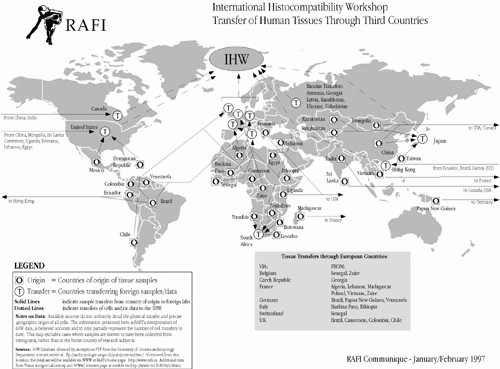
Nuevas Interrogantes Acerca del Manejo e Intercambio de Tejido Humano en el Instituto Nacional de Salud de los Estados Unidos (NIH) Células Indígenas Patentadas

Iniciativa de colectas de tejido humano del Ejército de Estados Unidos; células colombianas de indígenas en EE.UU, mapas sobre puntos de colecta en Papua Nueva Guinea y en Colombia.

Nadie controla ni monitorea el flujo transfronterizo de recursos genéticos humanos entre investigadores militares y civiles, que se da de forma irrestricta. El patentamiento de una línea celular de una persona de la cultura Hagahai de Papua Nueva Guinea, revela las deficiencias éticas y de derechos humanos en la investigación médica y en los protocolos intergubernamentales.

The Geopolitics of Biodiversity: A Biodiversity Balance Sheet

Crucial Decisions in 1996. The Real Hot Spots.

RAFI's survey of agricultural biodiversity reveals that 75% of ex situ genetic resources and technology are held in the North, while 83% of in-situ genetic resources and technology are held in the South. Multilateral regimes for agricultural biodiversity management must insure that proceeds from biodiversity benefits go to the South's farmers.

Bioprospección/biopiratería y comunidades indigenas

Galería de la Verguenza de los Bioprospectores... o Adivine Quién Viene a Piratear sus Plantas! Bilateralismo vs. Multilateralismo

La prospección de la biodiversidad es la exploración, extracción y análisis de los recursos genéticos y biológicos, en sí mismos y en relación a los conocimientos indígenas, para evaluar su posible aplicación industrial como recursos genéticos y bioquímicos de alto valor comercial. En la amplia mayoría de los casos, RAFI los denomina casos de "biopiratería".

Bioprospecting/Biopiracy and Indigenous Peoples

Bio-Prospectors Hall of Shame...or Guess Who's Coming to Pirate Your Plants?! Pros and Cons of Bilateral Bioprospecting Agreements

ISSUE: Biodiversity prospecting is the exploration, extraction and screening of biological diversity and indigenous knowledge for commercially valuable genetic and biochemical resources. Bilateral bioprospecting agreements are sanctioned by the multilateral Convention on Biological Diversity. In the vast majority of cases, however, commercial bioprospecting agreements cannot be effectively monitored or enforced by source communities, countries, or by the Convention, and amount to little more than "legalized" bio-piracy.

Sixty-Five Years of the U.S. Plant Patent Act (PPA)

Has the PPA Benefitted Society? The PPA's Relevance for the South.

RAFI examines plant utility patents granted by the US Patent and Trademark Office from 1985 through mid-1995. Utility plant patenting is a threat to world food security; exceedingly broad patents on biological materials and the processes used to manipulate them are "locking up" new plant biotechnologies in the hands of a small number of corporations.

Biopiracy Update: A Global Pandemic

Cases from Thailand, Gabon, Ecuador, and Peru

This issue looks at biopiracy case studies around the world including super-sweet brazzein from Gabon; the Foundation for Ethnobiology in Thailand; Peruvian indigenous peoples' rejection of Washington University's ICBG project; and more. A detailed list of bioprospecting and biopiracy activities (as of early 1996) is also included.

También en ésta edición...Informe sobre la biopiratería

Casos de Tailandia, Gabon, Ecuador, y Perú Lista de biopiratería/bioprospección

Este informe analiza estudios de casos en varias partes del mundo, entre ellos, la brazzeina super-dulce de Gabón, la Fundación para la Etnobiología en Tailandia, el rechazo de pueblos indígenas al proyecto ICBG de la Universidad de Washington en Perú y otros. Se incluye también una lista detallada de actividades de biopiratería y bioprospección (hasta 1996).

Páginas

Suscribirse a Recent content