Financial Report
Enviado por ETC Staff el
Years covered:
2008-2009

Enviado por ETC Staff el
La galerie contient toutes caricatures de RAFI et ETC Group.
Le droit d'auteur: Reymond Pagé ou Stig. Pour en savoir plus, lisez notre page Crédits.
VOLER CES CARICTURES! Merci de ne pas les modifier et de mentionner la source et l'auteur.
Cliquez sur une miniature pour afficher la version complet.
Enviado por ETC Group el
Enviado por ETC Group el
Communiqué et avis aux médias
If you are a journalist or organization that has interviewed a member of our staff and would like to add them to this page, please email the file and/or URL to joelle@etcgroup.org.
Enviado por ETC Staff el
Silvia Ribeiro *
Enviado por ETC Staff el
El 27 de julio pasado, el secretario de Agricultura, Alberto Cárdenas Jiménez, presentó otro componente de la farsa de bioseguridad en México: la Red Mexicana de Monitoreo de Organismos Genéticamente Modificados, otra forma de subsidiar con recursos públicos a las trasnacionales de los transgénicos.
Enviado por ETC Group el
Montreal - As hundreds of delegates gathered for the Sixth Annual Conference on Industrial Biotechnology and Bioprocessing at Palais des congrès in Old Montreal, a group of NGOs held an early morning press conference across the street.
Enviado por Silvia Ribeiro el
Silvia Ribeiro* Aunque los casos comprobados de gripe porcina humana llegan a más de 100 mil en el mundo y se teme que las próximas mutaciones del virus lo harán más letal, los gobiernos y la Organización Mundial de la Salud (OMS) se esfuerzan en ignorar las causas reales de la pandemia. En lugar de ello, predominan los enfoques fragmentarios y sobre los síntomas, como el desarrollo de una vacuna contra el nuevo virus, que aunque tenga corta vida efectiva y hasta podría empeorar la situación, es un gran negocio para las trasnacionales que dominan ese mercado.
Enviado por ETC Group el
Montreal. Several groups including Greenpeace, ETC Group and Biofuelwatch are warning that the biotech lobby will mount a major green-washing public relations exercise during the Sixth Annual Conference on Industrial Biotechnology and Bioprocessing that will be held at the Palais de congrès (19-22 July 2009).
Enviado por ETC Group el
El 10 de julio de 2009, el Tribunal de Apelaciones de los Estados Unidos para el Circuito Federal determinó que la patente estadounidense 5,894,079 (sobre el frijol Enola), que reclama derechos sobre un frijol amarillo campesino, de origen mexicano, no es válida porque ninguno de los reclamos de la patente cumple con el criterio de “no obviedad”. El caso ha sido seguido de cerca por grupos de la sociedad civil preocupados por la biopiratería, el patentamiento de seres vivos y el control empresarial de la producción alimentaria. En México, este frijol es conocido como “mayocoba”.
Enviado por Silvia Ribeiro el
Silvia Ribeiro* Un nuevo informe científico muestra que la contaminación transgénica del maíz en México está más extendida de lo que se creía, pero además, que el gobierno ha contribuido activamente a aumentarla a través de sus propios programas. El estudio publicado en mayo de 2009 en la revista PLoS One, fue presentado en México por la Unión de Científicos Comprometidos con la Sociedad (UCCS).
Enviado por ETC Staff el

Nano-scale technology is a suite of techniques used to manipulate matter at the scale of atoms and molecules. “Nano” is a measurement – not an object. Unlike “biotechnology,” where you know that bios (life) is being manipulated, “nanotechnology” speaks solely to scale. A “nanometre” (nm) equals one billionth of a metre. One human hair is about 80,000 nanometres thick. It takes ten atoms of hydrogen side-by-side to equal one nanometre. A DNA molecule is about 2.5 nm wide. A red blood cell is vast in comparison: about 5,000 nm in diameter. Everything on the nano-scale is invisible to the unaided eye and even to all but the most powerful microscopes.
Enviado por Silvia Ribeiro el
Silvia Ribeiro* La Academia Americana de Medicina Ambiental (AAEM, por sus siglas en inglés), hizo pública en mayo 2009 su posición sobre los alimentos transgénicos. "Por la salud y la seguridad de los consumidores" llaman a establecer urgentemente una "moratoria a los alimentos genéticamente modificados y la implementación inmediata de pruebas independientes y de largo plazo sobre su seguridad".
Enviado por ETC Staff el

After four days of difficult negotiations among 121 governments at a UN Food and Agricultural Organization Treaty meeting on the use of plant genetic resources for food and agriculture held in Tunisia, a Canadian effort to block progress was overturned. At midnight on Thursday, Brazil read an amended resolution on farmers’ rights to a tired plenary, shifting the prevailing tension amongst delegates into relief and enthusiasm. Following corridor negotiations, in which Europe, Latin America and Africa confronted Canada’s effort to derail the implementation of farmers’ rights, governments agreed to: ...
Enviado por ETC Staff el
Después de cuatro días de difíciles negociaciones entre 121 gobiernos en la reunión del Tratado de la FAO sobre Recursos Fitogenéticos para la Alimentación y la Agricultura que tuvo lugar en Túnez, representantes de la sociedad civil derrotaron el intento de Canadá por bloquear las negociaciones que favorecen a los agricultores. A media noche del jueves, Brasil leyó ante una cansada plenaria una resolución sobre los derechos de los agricultores que cambió por alivio y entusiasmo la tensión prevaleciente entre los delegados.
Enviado por ETC Staff el
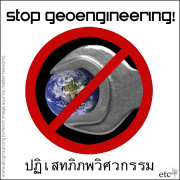
U.S. Energy Secretary Steven Chu’s speech last week advocating painting rooftops and roadways white to reflect sunlight may be yet another attempt to test the international waters on the controversial subject of geoengineering.[1] “We need an unequivocal statement from the White House that the U.S. Government is not green-lighting geoengineering in the run-up to Copenhagen,” said Pat Mooney, Executive Director of ETC Group, an Ottawa-based civil society organization monitoring new technologies.
Enviado por ETC Staff el
Le discours prononcé la semaine dernière (May 2009) par Steven Chu, Secrétaire à l’énergie des États-Unis, qui proposait de peindre les toitures et les routes en blanc afin de réfléchir les rayons solaires, pourrait bien constituer une nouvelle tentative de tâter le terrain international sur le sujet controversé de la géoingénierie.[i] « À la veille de la conférence de Copenhague, il importe que la Maison-Blanche déclare de façon non équivoque que le gouvernement américain ne compte pas donner le feu vert à la géoingénierie », a dit Pat Mooney, directeur général de l’ETC Group, une organisation de la société civile vouée à la surveillance des nouvelles technologies et dont le siège se trouve à Ottawa. Préalablement à la rencontre des parties à la Convention-cadre des Nations Unies sur les changements climatiques (CCNUCC) au Danemark, en décembre prochain, les organes subsidiaires de la CCNUCC se réunissent cette semaine et la semaine prochaine à Bonn, Allemagne. « Un travail de peinture planétaire peut paraître anodin, mais ces toitures blanches pourraient constituer un dangereux précédent : l’utilisation d’une technologie en apparence inoffensive qui ouvre la porte à des initiatives plus risquées en géoingénierie », suggère M. Mooney.[ii] La géoingénierie englobe diverses manipulations délibérées à large échelle de l’environnement terrestre, dans le but premier de contrer les effets des changements climatiques.
Enviado por ETC Staff el
El secretario de energía de Estados Unidos, Steven Chu, pronunció un discurso que puede interpretarse como una provocación para averiguar cómo anda el ánimo internacional en el controvertido tema de la geoingeniería. [1] “Necesitamos una afirmación inequívoca de la Casa Blanca en el sentido de que el gobierno de Estados Unidos no está dando luz verde a la geoingeniería mientras se prepara la reunión de Copenhague”, advirtió Pat Mooney, director ejecutivo del Grupo ETC, organización de la sociedad civil que monitorea las nuevas tecnologías, con sede en Ottawa. La Convención Marco de las Naciones Unidas sobre el Cambio Climático (CMNUCC) se reunirá en Dinamarca en diciembre, mientras sus organismos subsidiarios tienen sesiones preparatorias esta semana y la próxima en Bonn, Alemania. “Si bien parece algo bueno abrir nuevas fuentes de empleo para los pintores de todo el planeta, blanquear los techos masivamente puede ser la delgada frontera hacia una tecnología que parece inocua pero que abre la puerta a esquemas de geoingeniería más riesgosos,” según Pat Mooney.[2] La geoingeniería se refiere a la manipulación en gran escala del ambiente de la Tierra, supuestamente para contrarrestar los efectos del cambio climático.

Para saber más sobre el Grupo ETC o para contactarnos.