Financial Statements
Enviado por ETC Group el
Years covered:
1997-1998
PDF File:

Enviado por ETC Group el
Enviado por ETC Group el
Enviado por ETC Staff el
CSO's and the Third System.
A 39 page document.
Enviado por ETC Staff el
RAFI's in-depth report on plant piracy, prepared in partnership with Heritage Seed Curators Australia, concludes that intellectual property regimes for plant varieties are inherently predatory upon the knowledge of indigenous peoples and farming communities.
Enviado por ETC Staff el
Europe's answer to the American Home Monster" Terminator Technology is the Verminator, a new chemically activated seed killer. The Verminator kills seeds - in one of the invention's claims - by switching on rodent fat genes that have been bioengineered into crops. Zeneca BioSciences (UK) is vying with the "Monster" (Monsanto) to become Top Cat in the global seed industry even if it means playing cat and mouse with farmers and destroying their age-old practice of saving and breeding crop varieties.
Enviado por ETC Staff el
Grameen Rejects Mean The American Home "Monster" is held at bay in Bangladesh - but who is going to monitor the micro-creditors? Since when is "empowerment through indebtedness" a solution for poor farming communities?
On 27 July 1998 Muhammad Yunus, managing director of the Grameen Bank of Bangladesh was reported by the BBC to have cancelled the Bank's planned relationship with Monsanto Corporation (often referred to as the American Home Monster" following its announced merger with American Home Products earlier this year). The abandoned arrangement would have given the micro-credit bank U.S.$250,000 to provide loans to poor farmers to buy Monsanto's agro-chemical and biotechnology products. Grameen's capitulation follows a month of intense international pressure that began June 25th when Yunus announced the Monsanto grant together with the Corporation's CSO, Robert Shapiro.
Enviado por ETC Staff el
Civil Society Organizations and the "Third System"
Enviado por ETC Staff el
The first half of 1998 witnessed a dramatic consolidation of power over plant genetics worldwide. The global seed trade is dominated by life industry giants whose vast economic power over plant germplasm has effectively marginalized the role of public sector plant breeding and research.
Enviado por ETC Staff el
The Grameen Bank's June 25th announcement that it will accept US$150,000 from Monsanto Corporation (St. Louis, MO. USA) to launch the Grameen Monsanto Center for Environment-Friendly Technologies is stirring up a storm of controversy throughout agricultural and rural organizations around the Third World. The surprise move was unveiled jointly by Muhammad Yunus, Managing Director of the Grameen Bank and Robert Shapiro, MonsantoÌs Chair and CEO. The company's initial grant is for soft loans to Bangladeshi farmers.
Enviado por ETC Staff el
Negotiations for a new International Undertaking took place on two fronts. The Commission Chair took a small regionally-representative group aside to discuss access and benefit-sharing in the Lebanon room while the Vice-Chair took on Farmers' Rights with the remainder of the delegation in the Green room. Both negotiating processes broke down when the North found itself without running room and the South presented "bottom line" positions in both arenas. Here's an overview of the dividing issues, what happened, and where diplomats can go from here.
Enviado por ETC Staff el
The only thing that can keep pace with the rate of agricultural biotechnological change these days is the speed with which the transnatinoal Life Industry is eating itself. in the last couple of years, Monsanto has spent more than $6.7 billion buying seed and other ag biotech companies. Now, American Home Products is merging with Monsanto for another $33 billion. Other massive mergers are inevitable within the next few months. That transnational agri-business wants to stop farmers from saving seeds and conducting their own plant breeding is hardly news.
Enviado por ETC Staff el
The Iceland government has been forced to postpone a bill to give genomics company, deCODE an exclusive license to collect current and retrospective medical information about all Icelanders into a central database and the sole right to commercial exploitation. A number of major concerns were cited in the announcement to postpone the initiative.
Enviado por ETC Staff el
The $33 billion merger between AHP and Monsanto will force the life industry into a race to see who will come out on top. The merger creates a new challenge for anti-trust and anti-monopoly law enforcement in the areas of pharmaceuticals, crop chemicals, plant breeding, human genomics, and livestock.
Enviado por ETC Staff el
By the year 2000 - after a 12,000-year history of farming - farmers may no longer be able to save seed or breed improved varieties. The problem is not the Millennium Bug but the Millennium Seed."
Enviado por ETC Staff el
As a result of solid NGO pressure, the ominous Terminator Technology" became a topic of substantive discussion and debate at the recent meeting of the Conference of Parties to the Convention on Biological Diversity (COP IV) in Bratislava, Slovakia, 4-15 May.
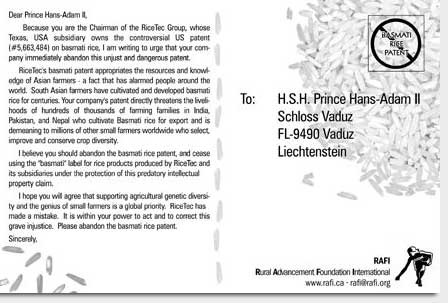
Hundreds of NGOs and government delegates attending the COP IV meeting in Bratislava were eager to sign postcards and mail them to Prince Hans-Adam II.
Enviado por ETC Staff el
Andean farmers forced Colorado State University to surrender its US patent on 'Apelawa" quinoa. The anti-patent campaign that began 14 months ago (1997) ended on May 1st 1998 when on eof the quinoa 'inventors' admitted that the patent had been abandoned.
Enviado por ETC Staff el
RAFI officially launched the latest in a series of civil society protests with an international postcard campaign aimed at Prince Hans Adam II, the Prince of Liechtenstein. The Prince is the chairman of the RiceTec Group, whose Texas-based subsidiary, RiceTec Inc., holds the controversial patent laying claim to Asia's famous aromatic on Basmati rice.
Enviado por ETC Staff el
Advocates for the newly patented terminator technology" developed jointly by the US Department of Agriculture and Mississippi-based Delta and Pine Land seed company claim that it will not only be an incentive to plant breeding investment but also a boon to food production in the South. This is "nonsense" according to RAFI Research Director, Hope Shand.
Enviado por ETC Staff el
A public row over the notorious US patent on the medicinal plant ayahuasca has broken out between COICA, the Coordinating Body of Indigenous Peoples' Organizations of the Amazon Basin, and the US government's Inter-American Foundation (IAF). In correspondence made public on the internet by COICA on March 4th, IAF has demanded COICA disavow a 1996 resolution approved by Amazonian indigenous peoples' organizations from 9 countries, that condemns the US plant patent (#PP5751) held by the International Plant Medicine Corporation (IPMC). IAF has further threatened to withdraw funding from groups that don't heed its command.

Para saber más sobre el Grupo ETC o para contactarnos.
