Recent content

Terminator Five Years Later

New Developments: While claiming not to have reversed their position against commercialization of Terminator seeds, some Gene Giants are continuing to seek new patents on genetic seed sterilization and others are boldly advocating in favor of GURTs (genetic use restriction technology) in intergovernmental negotiations. Stung by negative publicity related to the escape of DNA from genetically modified (GM) plants, industry continues to "greenwash" Terminator by promoting it as a biosafety tool for containing unwanted geneflow from GM plants. Biotech company Maxygen has unveiled a new technology designed to banish foreign DNA from GM plants as a way to silence critics of genetic engineering. ETC Group calls it the "Exorcist" technology.

La technologie Terminator, cinq ans plus tard

Depuis le mois de mars 1998, ETC Group (anciennement RAFI) surveille les travaux des multinationales de l'agrochimie et des semences visant à développer les semences Terminator - des plantes généticement manipulées pour que leur graines deviennent stériles (ce qui signifie que la seconde génération de semences ne germera pas).

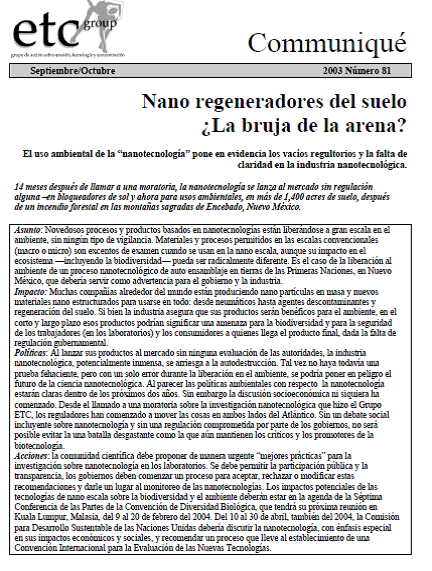
La nanotecnología y el Príncipe Precautorio

Las preocupaciones del Príncipe Carlos de Inglaterra en torno a la revolución emergente de la nanotecnología (que el Grupo ETC prefiere nombrar tecnología atómica), llegaron a los encabezados de los tabloides con el tema de la "plaga gris"( los nanorrobots autoreplicantes fuera de control y el apocalipsis inminente), tomando primeras planas en varios diarios del mundo. Sin embargo, estos virulentos ataques contra el Príncipe tal vez sean los los útimos de una serie de erorres técnicos y tácticos que los ambiciosos promotores de la nanotecnología están cometiendo.

Nanotech and the Precautionary Prince

Prince Charles' concerns about the emerging revolution in nanotechnology have catapulted tabloid headlines about "grey goo" (and impending doom) onto front pages around the world. Industry fears that the great GMO (genetically modified organisms) debate is about to go down to the nanoscale inhabited by atoms and molecules. But the virulent attacks against the Prince may only be the latest of a series of technical and tactical mistakes made by nanotech's over-eager proponents.

Monsanto's Species-Wide Patent on Trial

May 6-7 2003, European Patent Office Hears Patent Challenge in Munich - Eight and One-Half Years Later!

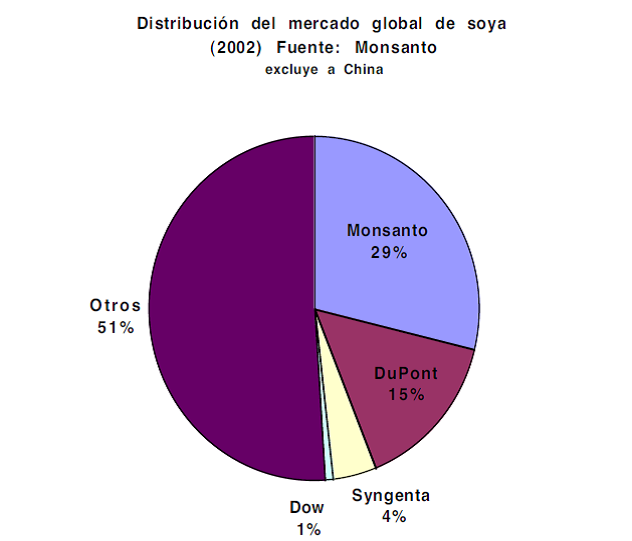
Remember 1994? Nine years ago: Yasser Arafat, Yitzhak Rabin, and Shimon Peres won the Nobel Peace Prize, Nelson Mandela was elected President of South Africa, US President Bill Clinton sent ground troops to the Persian Gulf to counter a move by Iraq's Saddam Hussein, and Brazil won the World Cup. The United Nations' Biodiversity Convention entered into force in 1994 and the Uruguay Round of GATT was drawing to a close. In the "life sciences" cosmos, Monsanto and Dupont were chemical companies with minor interests in seeds and Syngenta did not yet exist. ETC Group was known as RAFI. Also in 1994, a small biotech subsidiary of W.R. Grace, Agracetus, won a breathtakingly broad patent on all genetically modified soybean varieties, European Patent No. 301,749.

Broken Promise? Monsanto Promotes Terminator Seed Technology

At its annual meeting on Thursday, April 24th 2003, Monsanto's top brass will greet shareholders with a dismal financial report, (a 15% drop in annual sales - $4.7 billion in 2002, down from $5.5 billion in 2001) and a shareholder resolution that urges the company to re-think the safety of genetically engineered seeds - now the company's flagship product. But there's potentially more troubling news - a little known position paper that could rattle shareholders, irk investors and erode public confidence still further in the biotech behemoth: Despite its 1999 pledge not to commercialize Terminator technology, Monsanto has recently adopted a positive stance on genetic seed sterilization, a technology that has been condemned by civil society and some governments as an immoral application of genetic engineering.

Who Calls the Shots at UPOV?

US Government and Multinational Seed Industry Force UPOV to Abandon Critique of Terminator

After two days of intense diplomatic wrangling in Geneva, April 10-11 2003, US patent officials succeeded in turning the expert advice of an intergovernmental secretariat critical of Terminator technology into little more than a promotional paper for plant breeders' rights.

UPOV has succumbed to the strong-arm tactics of the US government and the multinational seed industry, both of whom have vested financial interests in Terminator technology. If member governments of UPOV had any doubts about who determines policy within the Union, they need only examine the recent case of Terminator.

El tamaño sí importa

Nueva información provee mayor evidencia para implementar una moratoria sobre las nano partículas sintéticas: Grupo ETC

Nueva evidencia de los riesgos de las nano partículas El Grupo ETC publicó el 14 de abril 2003 un nuevo documento de la serie Occasional Papers, con el título "Size Matters! No small matter II: The Case for a Global Moratorioum." El informe llama a los gobiernos a adoptar una moratoria sobre los nano materiales sintéticos que se están fabricando en los laboratorios y en algunos casos ya se están comercializando, ante la ausencia de pruebas sobre su inocuidad para la salud, la seguridad y sus impactos ambientales.

Size Matters!

ETC Group: New information provides more evidence for mandatory moratorium on synthetic nanoparticles

The ETC Group today (14.04.2003) releases a new Occasional Paper, "No Small Matter II: The Case for a Global Moratorium - Size Matters!" The report calls on governments to adopt a moratorium on synthetic nanomaterials that are being manufactured in the laboratory and in some cases commercialized, in the absence of testing for health, safety and environmental impacts.

"Even though industry is scaling up the manufacture of nanoparticles and carbon nanotubes there appear to be no government regulations in Europe or North America to ensure the safety of workers or consumers," says Kathy Jo Wetter, ETC Group researcher. "A few national governments are beginning to consider some aspects of nanotech regulation but no government is giving full consideration to the socioeconomic, environmental, and health implications of this powerful new industry," notes Wetter. The ETC Group reports that nanoparticles are already available to consumers in sunscreens (including some intended for children, from infancy onwards) and cosmetics, among other products. However, regulators do not test nano-sized materials for health, safety and environmental impacts if their macro- or micro-sized counterparts have already been approved.

La teoría del pequeño BANG. La estrategia de las tecnologías convergentes

Una mezcla de Bits, Átomos, Neuronas y Genes hace que el mundo gire… ¡para Estados Unidos!

Destacados formuladores de políticas y líderes industriales de Estados Unidos están diseñando un proyecto ‘Manhattan’ o ‘Apolo’ de nuevo tipo, para fusionar tecnologías estratégicas a nano escala (la millonésima parte de un milímetro). Su meta es combinar la biotecnología, la informática y las ciencias cognitivas (o neurales) con tecnologías atómicas a nano escala. (Consultar La inmensidad de lo mínimo en www.etcgroup.org). La unidad operativa de las ciencias de la información es el bit, la nanotecnología manipula los átomos, las ciencias cognitivas se ocupan de las neuronas y la biotecnología explota los genes. Las iniciales de bit, átomo, neurona y gene integran la palabra BANG. Fusionar esas tecnologías en una sola, dicen sus promotores, llevará a una revolución industrial gigantesca y a un “renacimiento” de la sociedad que garantizarán la dominación de Estados Unidos —tanto militar como económica— en el siglo 21.

The Little BANG Theory

A mix of Bits, Atoms, Neurons and Genes (B.A.N.G.) make the world come ‘round – for the USA!

In the USA, senior science policy makers and industry players are devising a new-style 'Manhattan' or 'Apollo' project to merge strategic technologies at the nano-scale (one billionth of a meter). Their aim is to combine biotechnology, information technology and cognitive (neural) science with atomtechnology at the nano scale (see The Big Down). The operative unit in information science is the Bit; nanotechnology manipulates Atoms; cognitive science deals with Neurons and biotech exploits the Gene. Together they make B.A.N.G. Merging these technologies into one, proponents say, will drive a huge industrial revolution and a societal "renaissance" that will guarantee American dominance - military and economic - through the 21st century.

El tamaño sí importa. Más evidencia para una moratoria global

No es poca cosa II: El caso para una moratoria global

Quienes fijan criterios en la industria y el gobierno aseguran que tamaño y las propiedades específicos de los materiales nanométricos no son razón suficiente para preocuparnos por los impactos que puedan tener en la salud, la seguridad y el ambiente. En este Occasional Paper, el Grupo ETC explica porqué el tamaño sí importa.

Green Goo: Nanotechnology Comes Alive!

The first and greatest impact of nano-scale technologies may come with the merger of nanotech and biotech - a newly recognized discipline called nanobiotechnology. While Gray Goo has grabbed the headlines, self-replicating nanobots are not yet possible. The more likely future scenario is that the merger of living and non-living matter will result in hybrid organisms and products that end up behaving in unpredictable and uncontrollable ways - get ready for "Green Goo!"

La nanotecnología cobra vida. Ahí viene la Plaga Verde

El impacto más importante de las tecnologías a nano escala podría resultar de la fusión de la nanotecnología y la biotecnología: una nueva disciplina apenas reconocida, llamada nanobiotecnología. Si bien la plaga gris saltó a los titulares apenas se comenzó a especular sobre ella, la realidad es que los nano robots autoreplicables están muy lejos de poderse fabricar. En cambio, el escenario futuro más probable es la fusión de la materia viva y la inerte a partir de lo cual se fabricarán organismos y productos híbridos, cuyas formas y comportamientos serán impredecibles e incontrolables.

La Inmensidad de lo mínimo

Tecnologías que convergen en la nanoescala

La inmensidad de lo mínimo: Tecnología atómica- tecnologías que convergen en la nanoescala, es el primer análisis completo y crítico de la nanotecnología, dirigido a la sociedad civil y los elaboradores de políticas. El informe, de 90 páginas, busca ampliar la percepción de la sociedad civil y los elaboradores de políticas más allá de la biotecnología y los cultivos transgénicos, y catalizar un amplio debate público sobre los impactos sociales de la nanotecnología.


The Big Down

Technologies Converging at the Nano-scale

The ETC Group (formerly known as RAFI) announces the publication of The Big Down: Atomtech — Technologies Converging at the Nano-scale, the first comprehensive and critical analysis of nanotechnology for civil society and policymakers. The 80-page report seeks to widen civil society’s and policymakers’ focus beyond biotech and genetically engineered crops, and to catalyze widespread public debate on the societal impacts of nanotechnology.

The Big Down

Atomtech - Technologies Converging at the Nano-scale

The Big Down: Atomtech - Technologies Converging at the Nano-scale, is the first comprehensive and critical analysis of nanotechnology for civil society and policymakers. The 80-page report seeks to widen civil society's and policymakers' focus beyond biotech and genetically engineered crops, and to catalyze widespread public debate on the societal impacts of nanotechnology.

Páginas

Suscribirse a Recent content