Recent content

Terminator – La suite

Même si les États ont réitéré et renforcé le moratoire des Nations unies sur Terminator (les technologies de restriction génétique, ou GURT) en mars 2006, des chercheurs du public et du privé préparent une nouvelle génération de semences-suicide – des plantes GM (génétiquement modifiées) dont la fertilité peut être activée ou désactivée par des commutateurs chimiques

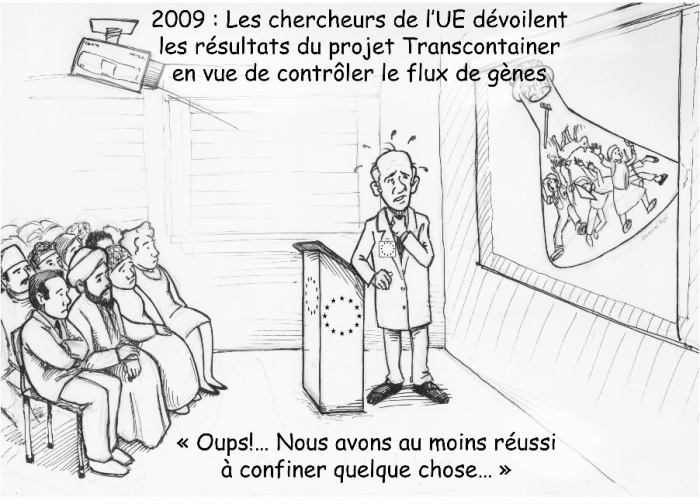
Les semences-suicide – La suite : le Transcontainer de l’UE transforme Terminator en zombie

TC Group lance aujourd’hui Terminator -La suite, un communiqué sur une nouvelle recherche en rapport avec les semences-suicide et autres technologies relatives aux semences GM (génétiquement modifiées) qui constituent une menace inacceptable pour les agriculteurs, la biodiversité et la souveraineté alimentaire.

ETC Group nous parle aujourd’hui d’une nouvelle cuvée de technologies du génie génétique, présentées comme une solution biosécuritaire à la dissémination non désirée des transgènes de cultures, arbres et plantes pharmaceutiques GM. En pratique, la commercialisation de ces technologies permettra aux multinationales des semences d’affermir leur emprise sur les semences exclusives et de gruger les droits des agriculteurs.

In Vivo, In Vitro, In Venter...?

In Vivo, In Vitro, In Venter...?
Español

Is Craig Venter, the so called "bad boy of biology", about to announce the world's first synthetic lifeform? (or 'Syn' for short)... we don't know. According to New Scientist "rumours are circulating that his institute will soon unveil the first synthetic bacterium". What we do know is that he has applied for a patent with broad claims that include a synthetic organism itself...

Patenting Pandora’s Bug: Goodbye, Dolly...Hello, Synthia!

J. Craig Venter Institute Seeks Monopoly Patents on the World's First-Ever Human-Made Life Form

Ten years after Dolly the cloned sheep made her stunning debut, the J. Craig Venter Institute is applying for a patent on a new biological bombshell - the world's first-ever human-made species. The novel bacterium is made entirely with synthetic DNA in the laboratory.

Los microbios salen de la Caja de Pandora

Adiós Dolly… ¡Hola Sintia! El Instituto J. Craig Venter busca patentar el primer ser vivo artificial creado en un laboratorio

El Grupo ETC apelará legalmente contra las patentes sobre “Sintias” (Organismos vivos sintetizados en laboratorio)

Diez años después del nacimiento de Dolly, la oveja clonada, el Instituto J. Craig Venter ha solicitado una patente sobre una nueva bomba biotecnológica: la primer especie hecha completamente en un laboratorio. Se trata de una bacteria construida totalmente con ADN sintético.

El Instituto Venter —que toma el nombre de su creador y financiador, J. Craig Venter, el científico que encabezó el sector privado en la carrera para mapear el genoma humano— ha solicitado patentes en todo el mundo sobre lo que ha bautizado como “Micoplasma laboratorium”. El Grupo ETC apodó a este organismo sintético, “Sintia”.

Synthia’s last hurdle?

Synthia – the “Original Syn” artificial microbe – may have jumped a hurdle that Dolly – the cloned sheep – never could

Synthia, the (theoretical) human-made synthetic microbe – still barely a twinkle in J. Craig Venter’s eye – may be in search of a surrogate micro-mom sometime very soon. According to a research report released today in Science magazine, Synthia (the subject of a patent application discovered by ETC Group a few weeks ago -see “Goodbye Dolly -- Hello Synthia!”) may have overcome her last hurdle. The report, authored by Craig Venter and his colleagues at Synthetic Genomics Inc., claims to have inserted a foreign bacterial genome into the cell of another bacterial species. Nobel laureate Hamilton Smith who is one of Venter’s co-authors in the research article told a meeting of synthetic biologists in Zürich on Monday that this represents a significant step en route to building a whole new life form. As the article itself concludes, “…we have discovered a form of bacterial DNA transfer that permits … recipient cells to be platforms for the production of new species using modified natural genomes or manmade genomes…”

Solicitud de patente del Instituto Venter sobre la primera especie del mundo sintetizada totalmente en laboratorio

El 31 de mayo de 2007 la Oficina de Patentes y Marcas Registradas de Estados Unidos (US PTO por sus siglas en inglés) publicó calladamente una memorable solicitud de patente que señala un parteaguas en la evolución como la conocemos. La solicitud de patente número 20070122826, titulada “Minimal bacterial genome” (genoma bacteriano mínimo), describe la creación en laboratorio del primer organismo vivo totalmente sintético; una bacteria nueva cuya información genética proviene de ADN sintetizado químicamente. Reclama derechos de propiedad exclusivos sobre “un organismo que puede crecer y reproducirse” hecho con un conjunto de genes esenciales que también se reclaman en la solicitud. La existencia de esta solicitud de patente no significa que el organismo sintético ya estuviera en funciones cuando se hicieron los trámites (12 de octubre de 2006); sin embargo los solicitantes tienen la suficiente confianza en su proceso como para reclamar propiedad exclusiva del mismo, de manera pública y legal. El beneficiario de la patente sería el instituto científico con sede en Estados Unidos encabezado por el magnate de la genómica, J. Craig Venter. El Instituto Venter también presentó la solicitud de patente internacional ante la Organización Mundial de la Propiedad Intelectual (número WO2007047148, publicada el 27 de abril de 2007). El Grupo ETC, organización de la sociedad civil internacional con sede en Canadá, apelará esta patente.

Monsanto's Takeover of D&PL: The Nail's in the Coffin

Monsanto's Takeover of D&PL: The Nail's in the Coffin
Inglés

Last week the US Justice Department (DOJ) gave the green light for Monsanto's $1.5 billion takeover of the world's largest cotton seed company, Delta & Pine Land (D&PL) -- the company that has long vowed to commercialize Terminator seeds (more on that below). The so-called "anti-trust" regulators approved the deal with a number of conditions. For instance, Monsanto must sell Stoneville, one of its largest cotton seed holdings, to multinational Bayer. The company must also agree to license its biotech traits to major competitors like Syngenta and Dupont.

¿Soberanía alimentaria o Revolución Verde 2.0?

La bala de plata tiene un arma...

El Grupo ETC publica en español el Communiqué de 16 páginas ¿Revolución Verde 2.0 para África?, describiendo cinco nuevas iniciativas para “mejorar” la agricultura en ese continente.

Los proyectos principales son la construcción de cuatro centros de excelencia agropecuaria y la fuerte inversión de las Fundaciones Bill and Melinda Gates y Rockefeller en una “Alianza para una Revolución Verde en África”, AGRA por sus siglas en inglés.

Will Canada Ban Terminator?

Will Canada Ban Terminator?
Inglés

In the last few years it would have been fair to "blame Canada" for trying to overturn the international moratorium on terminator seeds. Thankfully if a new initiative in Ottawa suceeds the Canadian government may be forced to change its tune.

A bill to prohibit field testing and commercialization of Terminator seed technology was introduced in the Canadian Parliament today by the Agriculture critic (ie spokesperson) for the NDP party.

Bill to Ban Terminator Introduced in Canada

A bill to prohibit field testing and commercialization of Terminator seed technology was introduced in the Canadian Parliament. Terminator refers to plants that are genetically engineered to render sterile seeds at harvest - a technology that aims to maximize seed industry profits by preventing farmers from re-planting harvested seed.
"Canada needs to pass this bill into law because genetic seed sterilization is dangerous and blatantly anti-farmer - suicide seeds threaten to intensify corporate control over Canadian agriculture and offers no benefits for farmers," said Colleen Ross of the National Farmers Union.

Terminator: The Sequel

Despite the fact that governments re-affirmed and strengthened the United Nations’ moratorium on Terminator technology (a.k.a. genetic use restriction technology [GURTs]) in March 2006, public and private sector researchers are developing a new generation of suicide seeds – using chemically induced “switches” to turn a genetically modified (GM) plant’s fertility on or off.

Issue: Under the guise of biosafety, the European Union’s 3-year Transcontainer Project is investing millions of euros in strategies that cannot promise fail-safe containment of transgenes from GM crops, but could nonetheless function as Terminator, posing unacceptable threats to farmers, biodiversity and food sovereignty. Terminator technology – genetic seed sterilization – was initially developed by the multinational seed/agrochemical industry and the US government to maximize seed industry profits by preventing farmers from re-planting harvested seed. Researchers are also developing new techniques to excise transgenes from GM plants at a specific time in the plant’s development, and methods to kill a plant with “conditionally lethal” genes. This new generation of GURTs will shift the burden of trait control to the farmer. Under some scenarios, farmers will be obliged to pay for the privilege of restoring seed fertility every year – a new form of perpetual monopoly for the seed industry.

News Release from the Galapagos National Park re: Planktos

The Galápagos National Park (entity in charge of managing and administering the two protected areas of the Galápagos Archipelago), is concerned with the US Company Planktos and its plans to experiment in waters near the Galápagos Marine Reserve. For this reason the park has been examining data to stop the Planktos experiment, which could affect the fragile ecosystems of the Galápagos Islands, declared a UNESCO World Heritage Site.

Further Reflections on EPO Decision to REVOKE Monsanto's Transgenic Soybean Patent

Further Reflections on EPO Decision to REVOKE Monsanto's Transgenic Soybean Patent
Inglés

Further reflections on EPO's May 3 decision to revoke Monsanto's species-wide soybean patent

ETC Group has been receiving lots of emails and phone calls in the past few days about the defeat of Monsanto's soybean patent one week ago. While most have been congratulatory a few have asked whether this wasn't in fact a hollow victory since the patent challenge was won on technical merits rather than fundamental principles of morality. Will it even affect Monsanto's patent portfolio? One US activist asked:

¡PATENTE REVOCADA! El monopolio de Monsanto anulado en Munich

Más vale tarde que nunca

Munich. La Oficina Europea de Patentes (EPO) puso un alto a la avaricia corporativa de Monsanto el 3 de mayo 2007, al revocar su patente total sobre los frijoles de soya genéticamente modificados (EP0301749), una patente sin precedentes por su increíblemente enorme alcance. El Grupo ETC, organización de la sociedad civil con sede en Canadá, ganó la batalla legal contra Monsanto después de 13 años, contra una patente de especie sobre los frijoles de soya, cuando la EPO sentenció que la patente no era nueva o suficiente (es decir, el paso inventivo argumentado no era lo suficientemente claro o contundente para que un especialista pudiera reproduciro). La demanda contra la patente estuvo respaldada por Greenpeace y por la red europea No Patents on Life. La Dra. Ricarda Steinbrecher de Econexus, con sede en Reino Unido, se unió al equipo contra la patente como experto científico.

We just defeated Monsanto! (or at least their patent!)

We just defeated Monsanto! (or at least their patent!)
Inglés

In the midst of our new fight over geoengineering near the Galapagos, we've got good news over a very old fight with Monsanto... Hope Shand just phoned from Munich to say that the European Patent Office has agreed with ETC's arguments and overturned Monsanto's soybean "species" patent. There is no further appeal!!

Geoengineers to Foul Galapagos Seas-Defying Climate Panel Warning

As the UN's top climate science panel, the IPCC, prepares to criticise the idea of geoengineering, one maverick geoengineering company, Planktos Inc, has announced it is about to dump several tonnes of tiny particles into the waters around the Galapagos Islands, covering an area larger than Puerto Rico. Doing so, they claim, will re-engineer the atmosphere, win them commercial carbon credits and perhaps a shot at the $25 million prize for greenhouse gas reduction put up by Richard Branson. Mainstream scientists are sceptical and environmental and social justice groups are crying foul.

REVOKED!! Monsanto Monopoly Nixed in Munich

but little joy in foiling soy ploy at this late date

Munich – The European Patent Office put the brakes on Monsanto’s over-the-top corporate greed by revoking its species-wide patent on all genetically modified soybeans (EP0301749) – a patent unprecedented in its broad scope. ETC Group, an international civil society organization based in Canada, won its 13-year legal challenge against Monsanto’s species-wide soybean patent when an EPO appeal board ruled that the patent was not new or sufficient (i.e., the invention claimed was not sufficiently described for a skilled person to repeat it). The patent challenge was supported by Greenpeace and “No Patents on Life!” Dr. Ricarda Steinbrecher of UK-based EcoNexus also joined the opposition team in Munich as a scientific expert.

Páginas

Suscribirse a Recent content