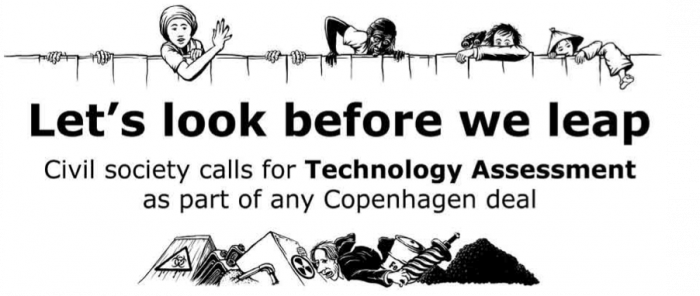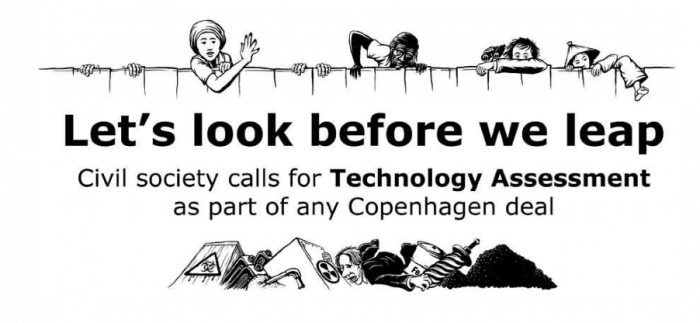
Declaración: ¡Miremos Antes De Saltar!
Enviado por ETC Staff el
Silvia Ribeiro*
En Chichicuautla, muy cerca de las porquerías de Granjas Carroll –incubadores de la influenza porcina–, la gente resiste. Resisten la contaminación brutal de tierras, aguas, aire y las enfermedades que les provoca esta carnívora trasnacional, propiedad de Smithfield, la empresa porcícola más grande del globo. Resisten también la represión que contra ellos ejercen los gobiernos estatales en acuerdo con las empresas.
Enviado por ETC Staff el
La reunión intergubernamental más importante sobre las crisis alimentaria y climática de 2009 ya ha ocurrido.
Enviado por ETC Group el
The declaration coming out of the World Food Summit for Food Security in Rome is even worse than the “shameful” document adopted by world leaders in 1996, so famously criticized by Cuba’s Fidel Castro. Governments won’t promise anything to anybody. The only issue really being debated in Rome is whether control of the UN’s “Department of Agriculture” will be wrested from the UN’s Rome-based agencies and surrendered to an amorphous, G8 conjured, public-private compact called the Global Partnership for Agriculture, Food Security and Nutrition. If the Partnership prevails, national sovereignty fails, and civil society's hopes for Food Sovereignty will suffer.
Enviado por ETC Staff el
En este número 100 del Communiqué de ETC actualizamos Oligopolio S.A. – la serie en la que hacemos un seguimiento de la concentración del poder corporativo en las industrias de la vida. También analizamos los intentos de las últimas tres décadas del agronegocio por monopolizar el 24 por ciento de la naturaleza que ha sido mercantilizada, y denunciamos una nueva estrategia que procura captar las tres cuartas partes restantes que, hasta ahora, han permanecido fuera de la economía de mercado.
Enviado por ETC Staff el
Silvia Ribeiro*
Contra viento y marea, en medio de innumerables críticas e irregularidades, el gobierno aprobó hasta el 27 de octubre, 22 siembras "experimentales" de maíz transgénico a favor de las trasnacionales Monsanto, Dow Agrosciences y Pioneer Hi Bred (esta última, propiedad de DuPont).
Enviado por ETC Staff el
BARCELONA – The international civil society network Climate Justice Now! deplores the downplaying of expectations for the Copenhagen Climate Summit in Barcelona by industrialized countries, UNFCCC officials and the host of the Copenhagen Summit. On the eve of Copenhagen, there is still no real progress on targets, a naïve and dangerous reliance on market mechanisms, no commitment to human rights, and a frightening context in which some countries are beginning to talk seriously about dangerous climate techno-fixes.
Enviado por ETC Staff el
La red internacional de la sociedad civil Climate Justice Now! deplora la minimización en las expectativas de la Cumbre de Copenhague sobre el Clima, celebrada, en Barcelona, entre los gobiernos de los países industrializados, los funcionarios de la Convención Marco de las Naciones Unidas sobre el Cambio Climático (CMNUCC) y el anfitrión de la Cumbre. En la víspera de esta Cumbre, todavía no hay un avance real en los objetivos, prevalece una confianza ingenua y peligrosa sobre los mecanismos de mercado, no hay compromiso con los derechos humanos, y existe un contexto escalofriante en el que algunos países están comenzando a hablar muy en serio acerca de peligrosas soluciones técnicas.
Enviado por ETC Staff el
A principios de octubre del 2009, el Grupo de Córdoba –un pequeño grupo de expertos independientes sobre alimentación y agricultura (incluyendo a dos Relatores Especiales de las Naciones Unidas sobre el Derecho a la Alimentación, el primero y el actual) que se ha venido reuniendo durante los dos últimos años– publicó un breve análisis sobre el estado de la gobernanza global en alimentación y agricultura, y sobre la necesidad de colocar el Derecho a la Alimentación y los intereses de los campesinos y productores de pequeña escala en el centro de los debates sobre alimentación y cambio climático. El informe del Grupo se distribuyó ampliamente en la sesión del Comité de Seguridad Alimentaria Mundial de Naciones Unidas que se reunió a mediados de octubre, y está influyendo tanto en las deliberaciones en torno a la Cumbre Mundial sobre la Alimentación que se realizará en noviembre 2009, como en la Conferencia de Naciones Unidas sobre Cambio Climático en diciembre. A continuación, el informe, titulado “Una llamada del Grupo de Córdoba.”
El Grupo de Córdoba está formado por expertos con amplia experiencia en agricultura,
hambre, agro-biodiversidad y derechos humanos, convocados a título personal por
la Cátedra de Estudios sobre Hambre y Pobreza, que es una iniciativa conjunta de
la Universidad y la Diputación de Córdoba, España.
Enviado por ETC Staff el
At the beginning of October 2009, the Córdoba Group -- a small gathering of independent food and agrocultural specialists (including the first and current UN Special Rapporteurs on the Right to Food) that have been meeting over the past two years -- published a brief (two-page) analysis of the state of global governance around food and agriculture and of the need to place the Right to Food and the interests of peasant producers at the center of the food and climate debate. The Group’s report was widely distributed at the UN Committee on World Food Security that met in mid-October and is influencing deliberations around both the World Food Summit in November and the December Conference in Copenhagen on Climate Change.
The Cordoba Group is formed by senior experts on hunger, agriculture, agrobiodiversity and human rights, convened in his/her personal capacities by the Chair of Hunger and Poverty Studies, a joint initiative by the University and the Diputacion of Cordoba, Spain.
Enviado por ETC Group el
"We cannot solve our problems with the same thinking we used when we created them" - Albert Einstein. As global climate negotiations in Barcelona enter into the last week of talks before December’s Copenhagen summit, there continues to be more aggravation than agreement amongst negotiators.
Enviado por ETC Staff el
By 2050, or much sooner, we will be growing food under climatic conditions we’ve never seen before and learning that “normal” weather is an illusive fiction. Yet, we are told that global land grabs and plantations of agrofuels are a “win-win.” The truth is that policymakers don’t know enough about our food supply. We don’t know where our food comes from and we don’t know who is feeding the hungry today. We have absolutely no idea who will feed us in 2050. This report raises more questions than answers. It begins with a comparison of the likelihood of the industrial food chain and the peasant food web getting us through climate chaos.
Enviado por ETC Staff el
Silvia Ribeiro*
La autorización del gobierno para sembrar maíz transgénico en México es un crimen de proporciones históricas. Un puñado de funcionarios que están en su puesto por unos pocos años cargaron contra 10 mil años de trabajo colectivo de millones de campesinos e indígenas que crearon y cuidaron el maíz –uno de los cuatro granos bases de la alimentación mundial–, solamente para favorecer a unas pocas trasnacionales. La desproporción entre quienes tomaron esta decisión, lo que está en juego y quienes sufrirán sus consecuencias es abismal.
Enviado por ETC Staff el
The food and fuel crisis that only became apparent to OECD governments in early 2008 arrived as the Rome-based UN agencies (FAO, WFP, IFAD) were responding to external and internal evaluations that found all three organizations wanting. Most severely criticized was FAO (Food and Agriculture Organization).
Enviado por ETC Staff el
Para saber más sobre el Grupo ETC o para contactarnos.