Recent content

World’s Top 10 Chemical Companies

Biofeedstocks for Industrial Chemical Production

The world’s 50 largest chemical corporations control a global market valued at $697 billion in 2009. The top 10 chemical firms account for about 40% of the market. “Petrochemicals,” by definition, are derived from petroleum and other fossil fuels. With soaring costs, unpredictable supplies and more challenging extractions, the industry is already making a transition from petrochemicals to biomass feedstocks. (In 2010, the world’s top 50 chemical corporations rebounded with combined sales of approximately $850 billion, an increase of 25.3% over 2009.)

World’s Top 10 Energy Companies

Global Energy Giants Inching towards Bioeconomy

ndustry statistics on world energy consumption put the “Green Economy” in much-needed perspective: In 2010 the world’s energy consumption grew by 5.6% - faster than any year since 1973.31 Fossil fuels accounted for 88% of the world’s primary energy (oil 34%; coal 30%; gas 24%). Nuclear, hydroelectric and “renewables” account for the remaining 12%. Non-hydro “renewables” (wind, geothermal, solar, biomass and waste) – including biofuels – account for 1.8% global energy consumption. World biofuels production grew by 14% in 2010 – but accounted for just one-half of one percent of global primary energy consumption. The world's top 10 energy companies account for 25% of the estimated $7 trillion energy market. Many of the world’s largest energy enterprises are high-profile investors in synthetic biology. Not only do they seek a cleaner, greener image; they believe that future profits will depend on diversifying and controlling bio-based feedstocks for energy production.

Back to the Future?

The seal of the DoA proclaims that "Agriculture is the foundation of manufacture and commerce"

Even as new industrial platforms involving petrochemicals and electricity were gaining ground in the late nineteenth century, the newly formed United States Department of Agriculture (USDA) unveiled its official seal showing a plow with sheaves of maize depicted on the surface of a shield. Below the shield, an unfurled scroll bears the claim: AGRICULTURE IS THE FOUNDATION OF MANUFACTURE AND COMMERCE.

As the 20th century evolved, petrochemicals and their associated technologies displaced agriculture as the economy’s foundation, but the 21st century may see a return of agriculture’s primacy. The vision is of a transformed and transformative agriculture, however, where both input (i.e., feedstock and feedstock processing) and output are tailor-made for particular industrial uses. Commodity crops may no longer be identified in the traditional way; in the future, they’ll be engineered, proprietary products custom-designed to meet the needs of industrial biomass processors – whether for food, energy, materials or pharmaceuticals.

¿De regreso al futuro?

El sello del Departamento de Agricultura de Estados Unidos proclama que "La agricultura es la base de la manufactura y el comercio"

A pesar de que nuevas plataformas industriales (que incluían, por ejemplo, a la petroquímica y a la generación de electricidad) ganaban terreno a finales del siglo XIX, el entonces recién creado Departamento de Agricultura de Estados Unidos (USDA) develó su sello oficial, el cual ilustraba un arado frente a un hato de plantas de maíz, dibujados en un escudo. Bajo el escudo, un pergamino desenrollado contiene el lema: LA AGRICULTURA ES LA BASE DE LA MANUFACTURA Y EL COMERCIO. A medida que se desarrolló el siglo XX, las sustancias petroquímicas y sus tecnologías asociadas desplazaron a la agricultura como base de la economía, pero en el siglo XXI podríamos presenciar el retorno de la preeminencia de la agricultura. No obstante, la visión actual es la de una agricultura transformada y transformadora, en la que tanto los insumos (por ejemplo, las materias primas y su procesamiento) como los productos son prediseñados para usos industriales específicos. Los cultivos comerciales pueden ya no ser identificados de manera tradicional; en el futuro, serán productos patentados y diseñados a la medida por medio de ingeniería para cubrir las necesidades de los procesadores industriales de la biomasa, sea para alimentos, energía, materiales o fármacos.

The Greed Revolution

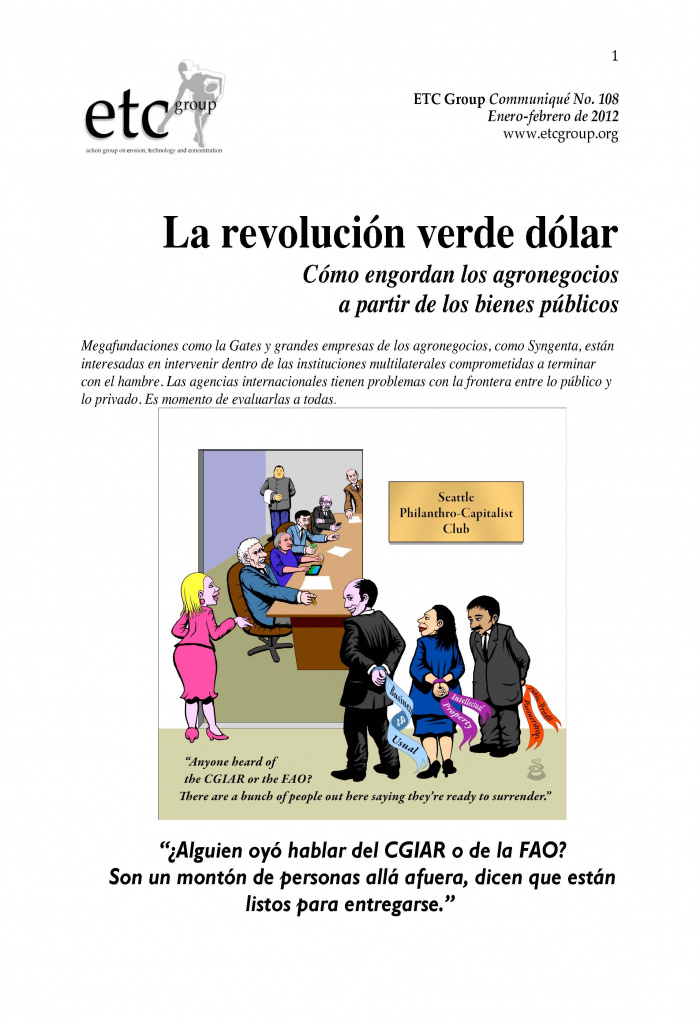
Mega Foundations, Agribusiness Muscle In On Public Goods

Big foundations like Gates and giant agribusinesses like Syngenta are taking an interest in multilateral public institutions committed to ending hunger. The international agencies are having trouble with the “public/private” boundaries. It’s time to evaluate them all.

ETC Group dedicates this Communiqué to the memory of Dr. Erna Bennett who passed away at the beginning of January 2012.

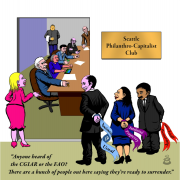
Issue: Three recent incidents show that the UN’s Food and Agriculture Organization (FAO) and the Consultative Group on International Agricultural Research (CGIAR) seem to be redacting their reports, or opening their gene banks and looking the other way as the private sector overrides governments and farmers to commandeer agricultural policy and practice. Private foundations and OECD states are causing public institutions to lose their focus on “public goods.”

Help us get access to specialised information

ETC Group's work is knowledge-intensive and requires us to read and analyse scientific, technical, legal, financial, policy and other reports. These include articles in peer-reviewed journals, patent applications, market reports and analyses, conference proceedings, legal briefs and more.

Unfortunately, much of the content we seek is proprietary information that is priced out of reach. If you are in a position to share relevant information that will help us do our work, please do let us know. We would be extremely grateful for your support.

Apartheid climático

Apartheid climático

Los resultados de la conferencia mundial de cambio climático realizada a principios de diciembre en Durban, Sudáfrica, son una condena a la humanidad, especialmente a los países del Sur más afectados por el caos climático, mientras que los grandes contaminadores evadieron cualquier responsabilidad u obligación y aseguraron los mercados de carbono para seguir lucrando con falsas soluciones a la crisis.

Crisis climática: la ingeniería del fracaso

Crisis climática: la ingeniería del fracaso

Se está realizando en Durban, Sudáfrica, la 17ª Conferencia de las Partes del Convenio Marco de Naciones Unidas sobre Cambio Climático (COP17) y por su falta de contacto con la realidad de la crisis climática –y de todas las demás, financiera, alimentaria, ambiental – parece ciencia ficción. Ante la vacuidad de las negociaciones, vuelven a la carga los proponentes de la manipulación climática alegando que ellos sí comprenden que es necesario tomar medidas enérgicas y que por ello necesitan más investigación y recursos en geoingeniería.

RIO+20

In June 2012 the global political focus will be on the next big environmental summit, the UN Conference on Sustainable Development, informally known as Rio+20 because it comes 20 years after the high profile Earth Summit of 1992.

Can the New Technology Mechanism Work for New Technologies?

The Case for Technology Assessment

International efforts to address the food, energy and climate crises give technology a central role to play. While some technologies may offer potential solutions to specific problems, decades of accelerating technological development and deployment have done little to mitigate climate change, and, in many cases, have made problems worse.

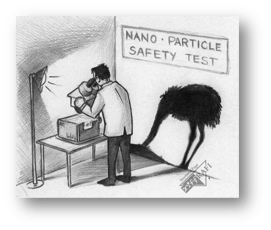
Now, new high-risk technologies, ranging from the very small (synthetic biology, genomics, nanotechnology) to the very large (geoengineering), are rapidly developing. Their promoters promise that these technologies are key to solving climate change,
world hunger, energy shortages and biodiversity loss. The precautionary principle and social and economic impacts are often ignored in the rush to deploy the latest technofix, marketed as socially useful and cutting edge, such as “climate-smart agriculture” or “next-generation biofuels.” Without the strict application of the precautionary principle, and a transparent and participatory form of technology assessment, new technologies could wreak even more havoc on a fragile planet that is already under immense strain due to reckless and unsustainable forms of production that serve the few at the expense of the many.

Impactos potenciales de la biología sintética en la conservación y uso sostenible de la biodiversidad

Contribución al Órgano Subsidiario de Asesoramiento Científico, Técnico y Tecnológico (OSACTT ) del Convenio sobre Diversidad Biológica

En concordancia con la Decisión X/13 del CDB, parágrafo 4, se somete el siguiente documento al Órgano Subsidiario de Asesoramiento Científico, Técnico y Tecnológico para su consideración. Esta contribución examina los impactos potenciales de la biología sintética y su relevancia con respecto a los tres objetivos del Convenio sobre Diversidad Biológica: la conservación y uso sustentable de la biodiversidad y el acceso y participación en los beneficios, justo y equitativo, derivado de la utilización de los recursos genéticos.

Civil Society Submission to the Convention on Biological Diversity

Synthetic Biology

This submission examines the potential impacts of synthetic biology and its relevance to
the three objectives of the Convention on Biological Diversity: the conservation and
sustainable use of biodiversity and the fair and equitable sharing of benefits arising from
the utilization of genetic resources.

Synthetic biology broadly refers to the use of computer-assisted, biological engineering to
design and construct new synthetic biological parts, devices and systems that do not exist
in nature and the redesign of existing biological organisms. While synthetic biology
incorporates the techniques of molecular biology, it differs from recombinant DNA
technology.

SBSTTA must not defer its consideration of synthetic biology as a new and emerging issue
requiring governance. Synthetic biology is a field of rapidly growing industrial interest. A
handful of products have reached the commercial market and others are in pre-commercial
stages. OECD countries currently dominate synthetic biology R&D and deployment, but
basic and applied research is taking place in at least 36 countries worldwide. Many of the
world’s largest energy, chemical, forestry, pharmaceutical, food and agribusiness
corporations are investing in synthetic biology R&D. Current applications of synthetic
biology focus on three major product areas that depend heavily on biomass feedstock
production processes: 1) biofuels; 2) specialty and bulk chemicals; 3) natural product
synthesis.

Qui Contrôlera l'Économie Verte?

Alors que les gouvernements s’apprêtent à consacrer l’Économie verte lors du Sommet Rio+20, ETC Group présente une réévaluation du pouvoir des entreprises et émet un avertissement selon lequel la course pour le contrôle de la biomasse perpétuera plutôt une économie motivée par la cupidité.

La perspective d’une grande transformation technologique débouchant sur une économie verte est largement diffusée à titre de clé de la survie de notre planète. L’idée maîtresse consiste à substituer l’exploitation de la biomasse (cultures alimentaires et textiles, herbacées, résidus forestiers, huiles végétales, algues, etc.) à l’extraction du pétrole.

Dans ce rapport traitant du pouvoir des entreprises, ETC Group soutient qu’en l’absence d’une gouvernance qui soit efficace et socialement responsable et d’une supervision gouvernementale, l’économie de la biomasse se soldera par une dégradation environnementale accrue, une perte de biodiversité inégalée et la disparition des biens communs qui subsistent.

ETC Group Submission to Rio+20

Tackling Technology: Three Proposals for Rio

he most dramatic technological transformation in history – involving information technologies, biotechnologies and engineering – has occurred since the first Rio Earth Summit in 1992; during the same period, however, governments have systematically downsized or eliminated their capacity to understand science and monitor technologies. While technology has thus far played an extraordinarily prominent role in preparatory documents for Rio+20, technology’s potential contribution to sustainable development and/or new Green Economies cannot be realized as long as the world lacks trusted and transparent mechanisms – at global, regional and national levels – for technology evaluation. The absence of such mechanisms incites distrust and invites disaster.

Páginas

Suscribirse a Recent content