Impulsores genéticos: malas influencias
Enviado por Veronica Villa el
Enviado por Dru Oja Jay el
The expert group that will be filing a report with recommendations to the UN Convention on Biodiversity met in early June, and examined a variety of emerging uses of synthetic biology. Jim Thomas was there representing ETC.
Increasingly, syn bio is moving out of the lab, and companies are conducting experiments and even genetic engineering in the wild – for example, by using viruses or gene drives to change genetic structures in nature.
Enviado por Dru Oja Jay el
Executive Summary
Enviado por Dru Oja Jay el
The following is an excerpt from ETC Group's May 2019 newsletter. To receive regular updates, sign up (see right sidebar)!
As converging global crises – biodiversity, climate, plastic – intensify, governments and corporations are scrambling to create new institutions and investors are lining up to finance a new round of buzzword-driven techno-fixes. Talk of “rapid technological change”, “exponential technologies”, “frontier technologies” and “the fourth industrial revolution” can be heard in hallways of a variety of governments, institutions and UN bodies.
Enviado por Dru Oja Jay el
The global meat industry is estimated to be worth over $1 trillion USD in 2019, and is projected to reach $1.5 trillion by 2022. The dairy industry is estimated at $442 billion. Industrially processed meat and dairy are notorious for the inhumane conditions of their livestock, and are a climate menace.
Enviado por Veronica Villa el
Prepared by ETC Group with additional research by Dr Elisabeth Abergel, for the International Union of Food, Agricultural, Hotel, Restaurant, Catering, Tobacco and Allied Workers' Associations (IUF)
Enviado por Dru Oja Jay el
Enviado por Veronica Villa el
Enviado por Silvia Ribeiro el
Silvia Ribeiro*
Enviado por Veronica Villa el
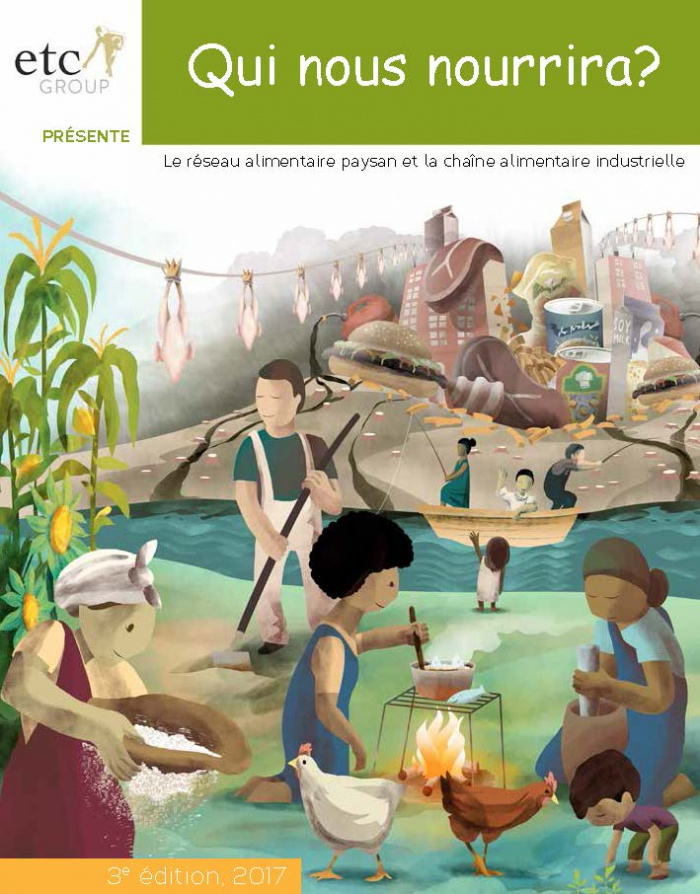
¿Quién nos alimentará? - Libro para descargar y videos
Enviado por Trudi Zundel el
More than a set of agricultural practices, agroecology is profoundly political, intertwined with food sovereignty and peasants’ and farmers’ rights. Small-scale farmers, peasants, pastoralists and small-scale fishers – who make up what ETC calls “The Peasant Food Web” – already grow 70% of the world’s food using only 25% of agricultural resources.
Enviado por Dru Oja Jay el
Exact date TBA
Enviado por Dru Oja Jay el
Déchiffrer les tendances scientifiques et technologiques émergentes fait partie intégrante du travail du Groupe ETC. Nous voulons saisir les implications des nouvelles réalités qui se font jour autour de nous, qu’il s’agisse d’intelligence artificielle, d’ingénierie sociale, de formes extrêmes de modifications génétiques, de concentration d’entreprises, de surveillance, d’autoritarisme ou de géoingénierie.
Enviado por Dru Oja Jay el
En el Grupo ETC nos es fundamental tratar de entender las tendencias emergentes en ciencia y tecnología. Queremos comprender las implicaciones de las nuevas realidades que están surgiendo a nuestro alrededor, ya sea que se relacionen con inteligencia artificial, ingeniería social, formas extremas de modificación genética, poder de las corporaciones, vigilancia, autoritarismo o caos climático.
Enviado por Dru Oja Jay el
Making sense of emerging trends in science and technology is a core part of what ETC Group does. We’re impatient to grasp the implications of new realities that are emerging around us, whether they relate to artificial intelligence, social engineering, extreme forms of digital genetic modification, corporate concentration, surveillance, authoritarianism or geoengineering.
Enviado por Silvia Ribeiro el
Silvia Ribeiro *
Los programas conocidos como REDD+ han sido usados en la década reciente como emblema de la supuesta sinergia de acciones para la conservación de bosques y el combate al cambio climático. Esto, pese a que han sido cuestionados por muchas razones, principalmente por comunidades y organizaciones de pueblos indígenas, que los han denunciado como otra forma de despojo de sus territorios.
Enviado por Veronica Villa el
El problema
Enviado por Silvia Ribeiro el
Silvia Ribeiro
Conejos y ovejas modificados con edición genética en China sufrieron efectos secundarios totalmente inesperados, como tener lenguas más largas y vértebras demás. Terneros modificados con este tipo de técnicas en Brasil y Nueva Zelanda enfermaron y murieron prematuramente. Crece la lista de impactos imprevistos de esas tecnologías de ingeniería genética.
Enviado por Dru Oja Jay el
Para saber más sobre el Grupo ETC o para contactarnos.